The following is another message from the Hardrocker Aero Design team in Rapid City, South Dakota. The team will represent the South Dakota School of Mines and Technology once again in the 2026 SAE Aero Design competition.
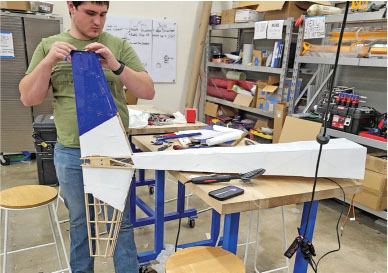
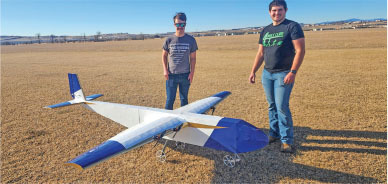
Two things caught my eye in what they sent along. First, many of the Hardrocker team members stayed at school during spring break to complete the airplane that you see pictured. Kudos to them on choosing the SAE competition instead of a few beers in Florida.
Second, I noticed one rule that is going to make the 2026 competition very interesting. Each year, there is a new design constraint in the SAE Heavy Lift rules set. This year, the teams are limited to a single 4S 2,200 mAh battery. Look at the airplane and tell me how challenging it will be to take off, complete a circuit, and land on that size of battery while carrying a 50- to 100-pound load. There are spaces in this fuselage for four shotfilled 2-liter pop bottles.
The team will compete in Texas at the end of April. By the time you read this, we will know the results. My best wishes to all of these young engineers.
Since it’s that time of year when the contributions to this column are thin, I thought I’d use a few inches of this space to pass on some advice that the Executive Council gets from AMA’s general council, Felix Gora. A couple of times a year, he visits with us about legal issues relating to AMA activities.
This advice pertains to AMA club liability. In the event that your club has something happen that draws the attention of lawyers and insurance agents, you can count on one question being asked: Has your club made a reasonable and prudent effort to create a safe environment?
Obviously, AMA and your club have a comprehensive set of safety rules to follow during flying activities, but there is another area I’d like to call to your attention: Most AMA insurance claims come from nonflying activities.
This means that you should also look for possible safety issues on your entire property. I would advise your members to make a formal examination of your flying field for hazards that might cause an insurance claim to be filed by visitors and spectators—especially children.
Look at your field through a child’s eyes. Here are a few examples to stimulate your thinking.
- Are there boxes or equipment close enough to a building that would allow access to the roof?
- Are there branches or debris piled in such a way that someone could fall and/or could cause an injury?
- Are there sharp edges on a barrier fence or steel siding?
- Are there low-hanging chains or ropes that a neck would hit in low light?
It’s also that time of year when your club might be doing some field maintenance. I would encourage you to include a field assessment for potential safety hazards such as these and correct them. List what you have done formally in your club minutes or newsletter. With this paper trail, should the need ever arise, you can show evidence that your club has made that "reasonable and prudent" effort.