WELCOME TO MY final article as the "Control Line (CL) Combat" columnist for Model Aviation. It’s been more than 10 years since Rich von Lopez handed the reins of the column to me, and I’ve decided that it’s time to pass the torch to someone else who will be better able to keep the community updated on the latest happenings in the sport.
At the time that I wrote this, a successor had not yet been identified, but by the time this article comes out (and well before the next column is due), I will ensure that a new columnist is on board and ready to take over the important task of promoting Combat, highlighting activity around the country (and the world), and providing useful tips that can help everyone in the community enjoy the hobby and succeed.
Useful Tip
Speaking of useful tips, here’s one that I picked up while flying with the Penguin Club when I lived in Denmark.
Whether you’re testing models solo, flying practice matches, or holding a contest, it’s always a good idea to fly with a true-to-size pilots’ circle that is marked out on the ground. For a contest, of course, it is a necessity. For practice matches and even for test-flying, having the pilots’ circle marked out in its regulation size is good for safety (to prevent pilots from wandering too far). It is also good for training your eyes and mind to watch for the boundaries of where you can move and to internalize those limits so that you don’t accidentally wander astray during a match and cost yourself precious points or even a disqualification.
Some clubs are fortunate enough to have a dedicated flying site with concrete center pads where the appropriately sized pilots’ circles for each event can be permanently painted. For the rest of us who fly over whatever patches of grass we are allowed and able to, flying with a pilots’ circle entails a significant investment of effort at the beginning of any flying session. You need field marking spray paint or chalk, a measuring tape, and some kind of system (either a second person or perhaps a screwdriver stuck in the ground) for holding one end of the measuring tape in place while the other walks around the perimeter of the circle marking the desired line.
Enter the Penguin Circle. Say goodbye to empty spray cans and accidental orange stripes across your shoes and say hello to a bag of aluminum tubes that practically assembles itself into a perfect circle, of the perfect size, in just seconds each time you go out to fly.
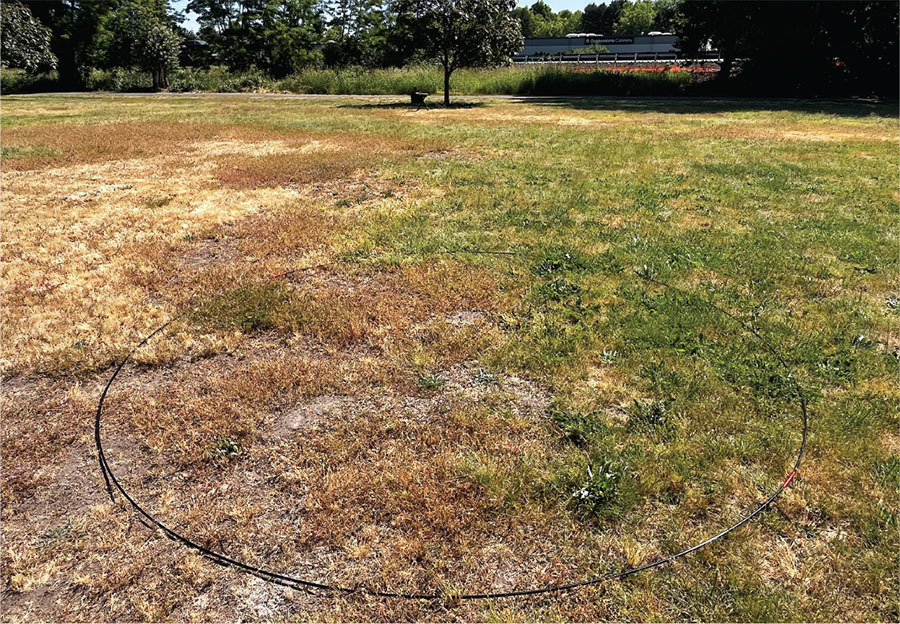
The idea is to use relatively thin, bendable camping tent poles to mark out the perimeter of your pilots’ circle. I use two strings of nominally 18-inch long, 3/8-inch outer-diameter aluminum tent poles that each assemble to a little more than 20 feet in length. The F2D pilots’ circle has a 2-meter radius, which translates to an approximate 41-foot circumference. By bending the two 20-foot poles into a circle, I get a 40-foot circumference circle. It’s undersized by close to 2 inches in radius, but for the convenience factor during weekly practice, I’ll take it.
Tent poles come (or can be) threaded onto an elastic cord that helps them nearly assemble themselves after taking them out of the bag. Once the two sets of poles are fully extended, I use two 5-inch long, 11mm (0.43-inch) inside-diameter aluminum tubes that are originally sold as tent pole repair splints to hold the ends of the two extended poles together as I bend them into a circle (see the photo). Naturally, the poles want to bend into a nearly perfect circle, which you can then plop down on your field wherever it is convenient. After flying, it takes just a matter of seconds to pull off the coupling splints and fold the poles back up into a neat, little package.
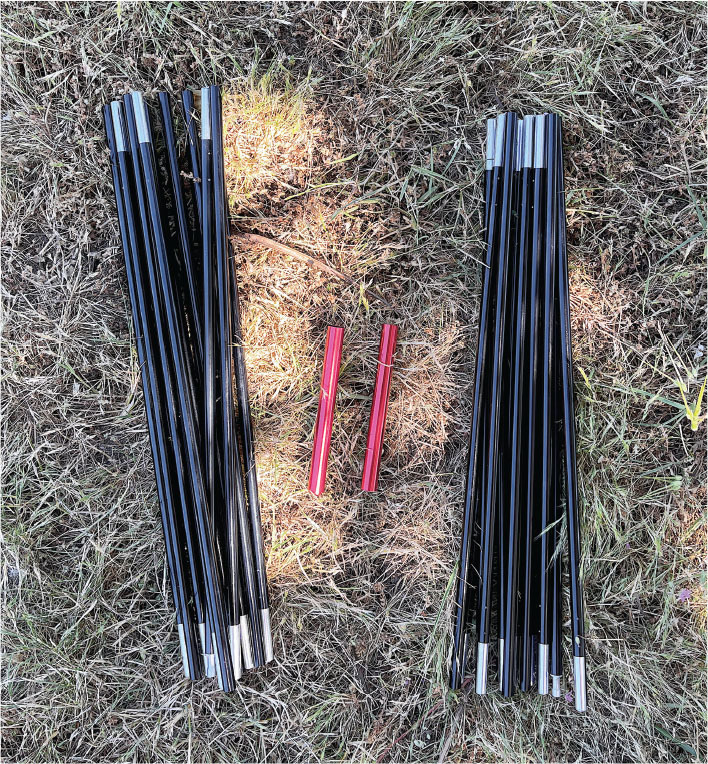
You can vary the material, pole diameter, length, and color (natural or with paint) as you see fit. This is also a great way to reuse or repurpose poles from an old, beat-up tent (either from your garage, a yard sale, etc.).
CL Combat at Joe Nall Week
On to competitions. I recently received a report from field reporters Chuck and Muffy Rudner about CL Combat at Joe Nall Week, which took place in May at the Triple Tree Aerodrome in Woodruff, South Carolina.
After the success of last year’s event, CL Combat was invited back this year for a full F2D competition. Thirteen pilots were on hand, including two Juniors and three international attendees from Team Mexico.
The field was in great condition, with soft, lush grass as far as the eye could see. With Arlene Mears set to run the contest and help from Dave Edwards and Muffy, all signs pointed to a great weekend of Combat ahead.
Apparently, though, the weather didn’t get the memo, and torrential rains were predicted for Sunday. To ensure that the competition could be completed, the judges and competitors worked together to run a tight ship with a good pace that enabled the full double-elimination tournament to be completed on Saturday.
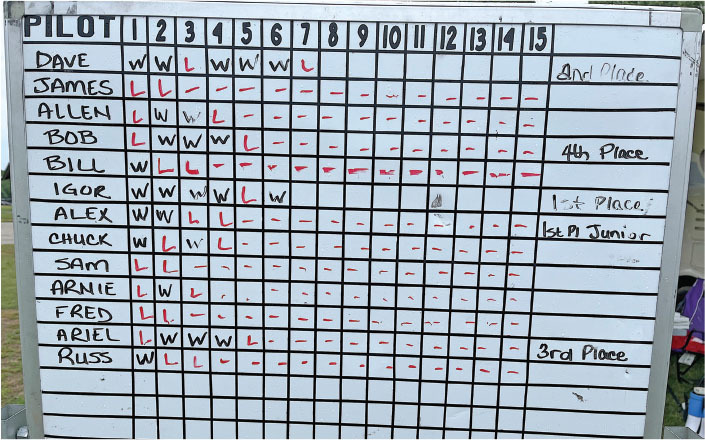
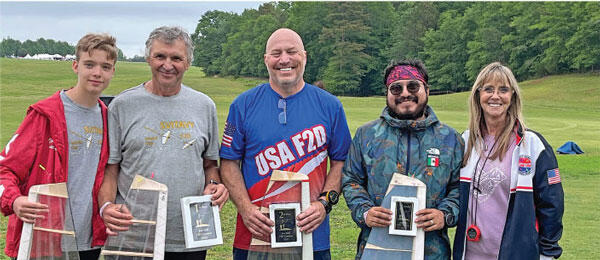
When all was said and done, Igor Dementiev emerged in first place, with Dave Fischer in second, and Ariel Quezada in third. Alex Dementiev finished as the firstplace Junior with two wins and two losses.
Despite the gloomy forecast, the weather on Sunday turned out to be amenable to flying. Because many of the pilots were still around, an additional single-elimination contest was organized for Sunday. After a few rounds of Combat and a rain break, three pilots eventually emerged for the finals: Dave Fischer, Bill Maywald, and Bob Mears.
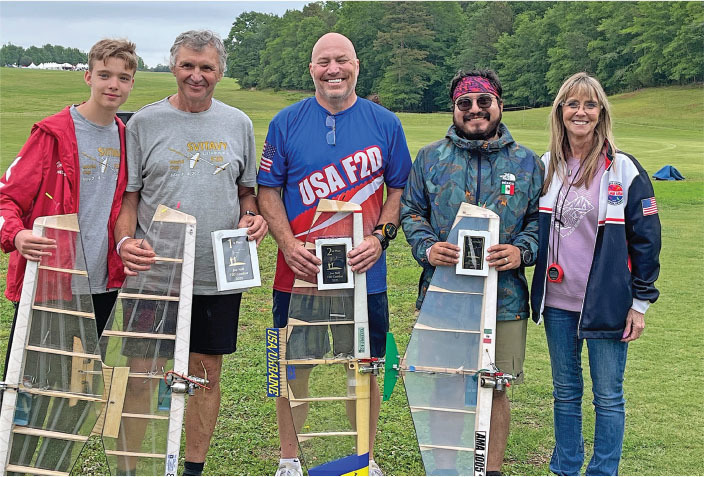
To spice up this special event, the three pilots agreed to fly a three-up final, with no pitting allowed. It was a battle for survival in the air. Although Dave had the advantage coming in because of his extensive experience in F2C Team Racing, he was the first one out. Bill and Bob then battled it out, until Bill finally came out on top, two cuts to one.
Kudos to all of the pilots for what all accounts say was a great weekend of flying, and congratulations especially to the winners of both competitions.
That’s a wrap for this article. Stay tuned for next time, with a new columnist and updates from what promises to be an exciting summer of flying around the country.
SOURCES:
Miniature Aircraft Combat Association (MACA)
Triple Tree Aerodrome


Comments
Add new comment