
THE INDOOR FREE FLIGHT (FF) season is well on its way this year, with several major contests in the books. The first contest in the Midwest was the Jim Richmond Open on April 5-7. It was held in the atrium at the West Baden Springs Hotel in southern Indiana.

This year’s event proved quite difficult for those who attended because the days leading up to the contest were packed with heavy rainfall, which caused local flooding around the site and surrounding town. The flooding closed some roads or parts of roads and made it difficult to get to your destination.
The poor weather did not help the flying conditions on the first day of the contest either. After the weather cleared out of the area, flying conditions improved on the second day, with good flying conditions on the last day. Hopefully the rain will stay away for next year!
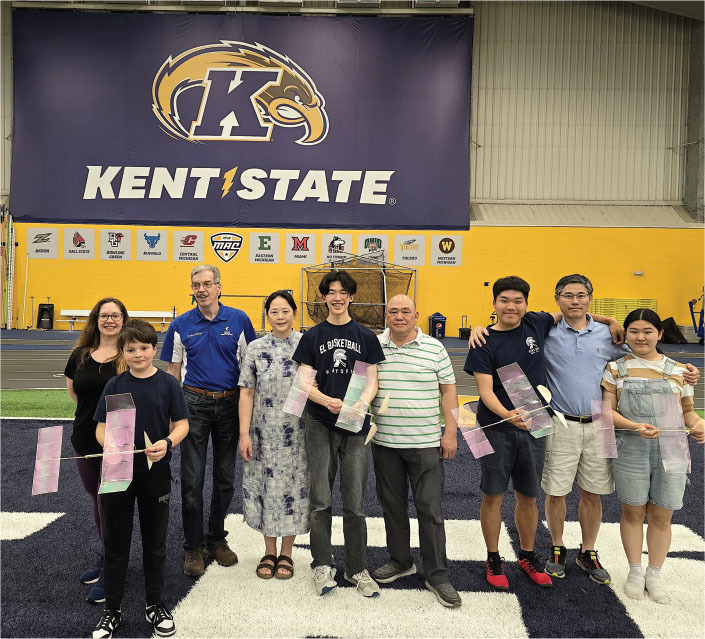
The next month, on May 17-18, the Midwest Indoor Championships were held in the fieldhouse at Kent State University in Kent, Ohio. This Category II flying site facility is where many of the current AMA Category II records have been set throughout the past 20-plus years.
This year was no exception, with six more AMA records being set. Grace Jeong set a new Youth Junior record in Limited Pennyplane, Pennyplane, and F1M, with a flight of 10:07. Her brother, Guhyun Jeong, set a new Youth Senior record of 10:23 in Limited Pennyplane and Pennyplane. Liam Scott set a new Youth Senior record in F1R with a time of 7:49. Congratulations to the new record holders!
Over the Memorial Day weekend, on May 25-27, the AMA Indoor FF Nats was held at Eastern Tennessee State University (ETSU) in Johnson City, Tennessee. The flying site hosted the AMA Nats and United States Indoor Championships for many years, mostly in the 1990s and 2000s. Throughout the years, a scoreboard and banners were installed, making the flying more difficult than in the past, especially in the middle where the site is the highest. One change for this year was that there was no astroturf on the main floor, which caused hard landings for some glider flights that went astray on launch.
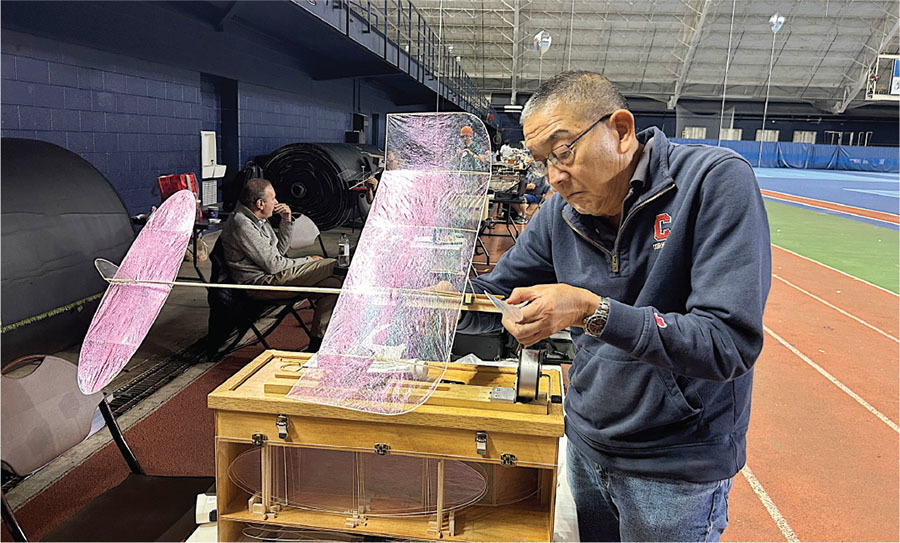
Flying conditions were good, with minimal drift after the air conditioners were shut down on Saturday. Those who flew above the bottoms of the hanging banners found that there was some drift at the top that required a steer or two to get away from the girders or the hanging light bar. At times, there was some drift toward the scoreboard, but after fliers were below it, the drift stopped. There are currently ongoing talks with ETSU about permanently removing the scoreboard since it is no longer functional.
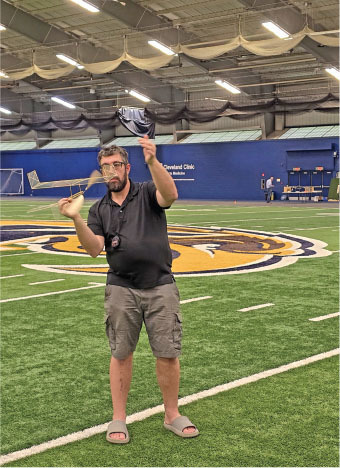
This year, the Indoor Nats was flown on a schedule with time slots for events on certain days. It had been done this way for many years in the past. I personally liked having the time slots this year because it allowed you to focus on a couple of events for a period of time, and then you could move on to other events after the time slot had ended. Sometimes things do not go as planned during a competition and you get bogged down trying to force something to work. A time slot that ends at a particular time can be a helpful reminder to tell yourself that you need to move on to the next event.
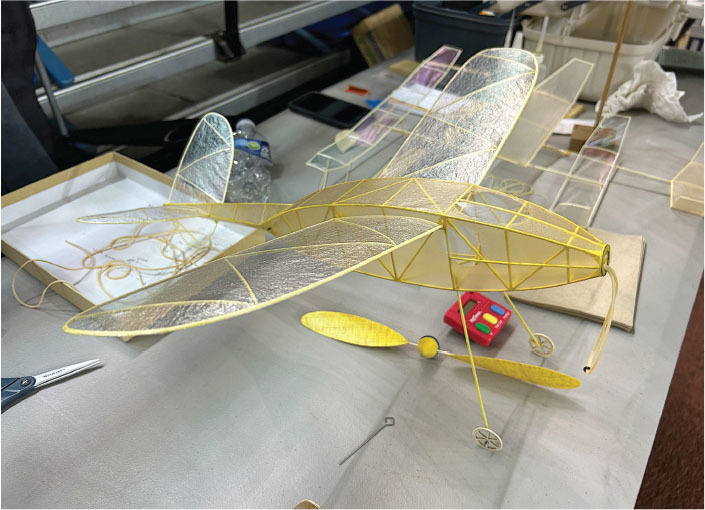
I also think that time slots allow people the opportunity to fly other events that they normally would not fly or have never flown before. This year, I decided to build an F1M to fly in the time slot with Pennyplanes. It was a new event for me, and I have been Indoor flying for more than 40 years.
The schedule also had fewer events than previous years. I feel that this makes the competition more interesting, especially during a Nats. With fewer events, fliers can then focus on tuning their models and optimizing rubber and trim to get better flight times.
This year’s Nats had a similar feeling to the Nats that I remember from 30 years ago. Back then, if you posted a good time, it might have only been a few minutes before you found out that you had slid down the leader board several places and had to fly again.
That happened this year in Pennyplane. With only about 30 minutes left to go, the lead changed multiple times, with the three top fliers within only 39 seconds of each other. The time-slot requirement also made it interesting because some last-minute launches were made to try and capture first place and resulted in contestants having to wait and see what would happen.
For me, this type of competition makes the events more exciting as a participant and what I expect at a Nats. It requires a modeler to adapt to the situation at hand and try to figure out what needs to be done under the conditions at that time to get a few more seconds than the next person, all while under the clock of a looming deadline of when the event ends. I hope this trend continues in future Indoor FF Nats.
Finally, I want to thank Dave Beazley and Dave Lindley for making the Indoor FF Nats run so smoothly. Dave Beazley did all of the contest director duties, while Dave Lindley kept the scores updated in real time with an online website that could be accessed by scanning a QR code on your cellphone to see each event’s current scores. This saved a lot of time for the contestants because we did not have to walk back and forth to see the latest scores.
Thanks to both Daves from all of the Indoor FF Nats contestants!
SOURCES:
National Free Flight Society (NFFS)
West Baden Springs Hotel/French Lick Resort
(888) 936-9360
AMA Indoor FF Nats
https://nats.modelaircraft.org/discipline/indoor-free-flight





Comments
Add new comment