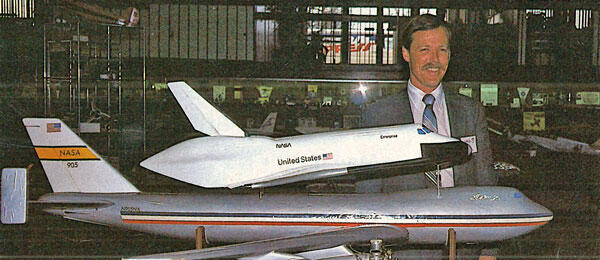
On the occasion of NASA’s donation of the full-scale Enterprise to the National Air and Space Museum, our author reports on the role in its development played by the RC space shuttle and 747 models on exhibit in the AMA Museum
By Luther Hux
As seen in the May 1986 issue of Model Aviation.
Bonus Video below after the article.

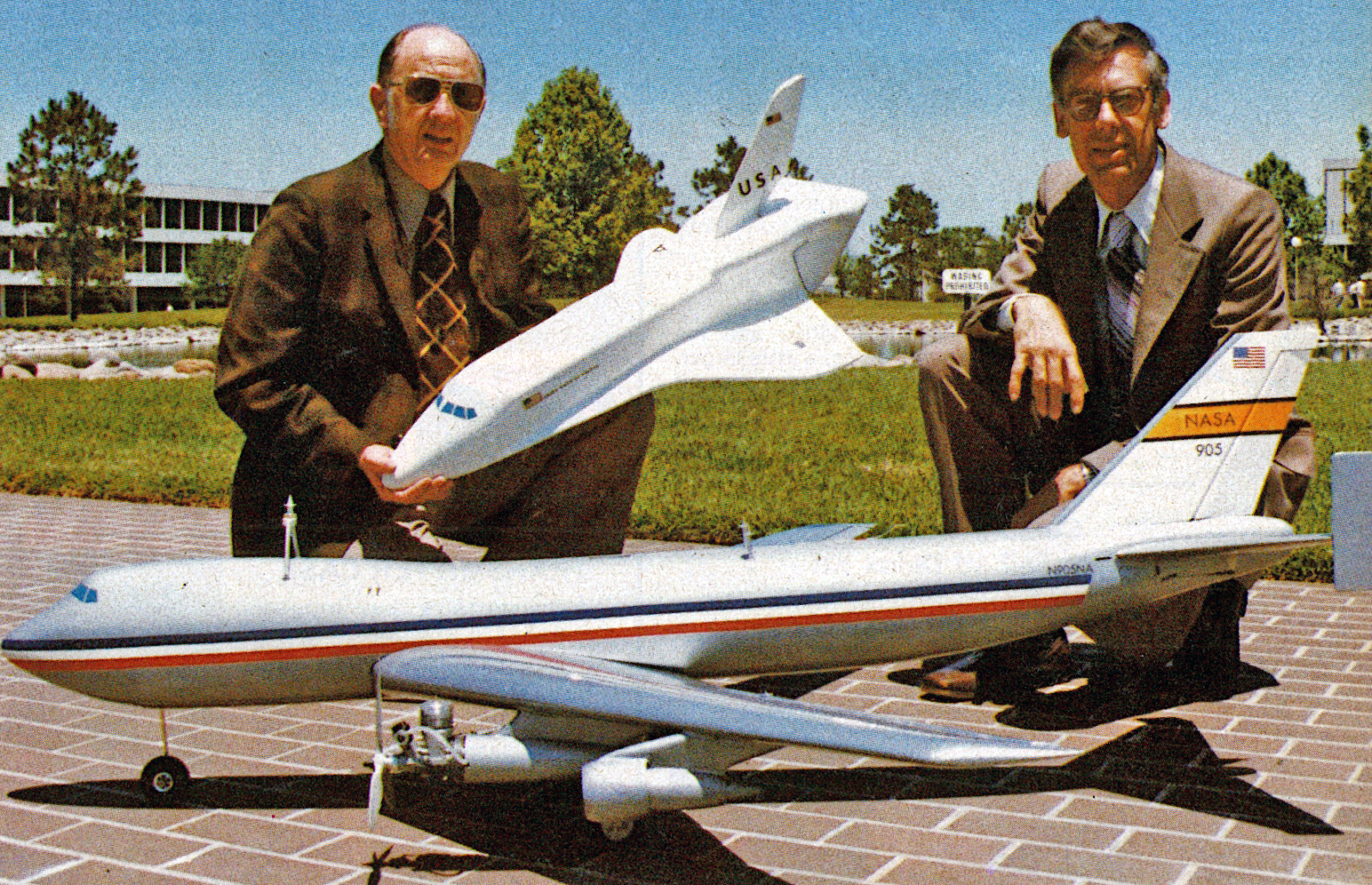
The [1986] acquisition of the Enterprise by the Smithsonian Institution has served as a reminder of the AMA Museum's space shuttle/747 exhibit. These models were prototypes for the full-scale Enterprise and its air carrier.
The full-scale counterparts of these models have visited the Washington, D.C., area twice in recent years. In June 1983, they landed at Dulles International Airport, and I was given a chance to take aerial photos from my Snapshot model. This was covered in the May 1984 Model Aviation. (library.modelaviation.com/article/day-project-snapshot)
In November 1985, NASA announced that the Enterprise would again land at Dulles. However, this was to be the last ride for the space shuttle before going into mothballs to await completion of the Smithsonian Institution National Air and Space·Museum annex in about 1990 at Dulles Airport. The Enterprise will be joined by other large aircraft, such as a Concorde, the Enola Gay, a 707, and a 747. The NA&SM annex will only be about a 10-minute drive from the National Center for Aeromodeling in which the AMA Museum and AMA HQ are located.
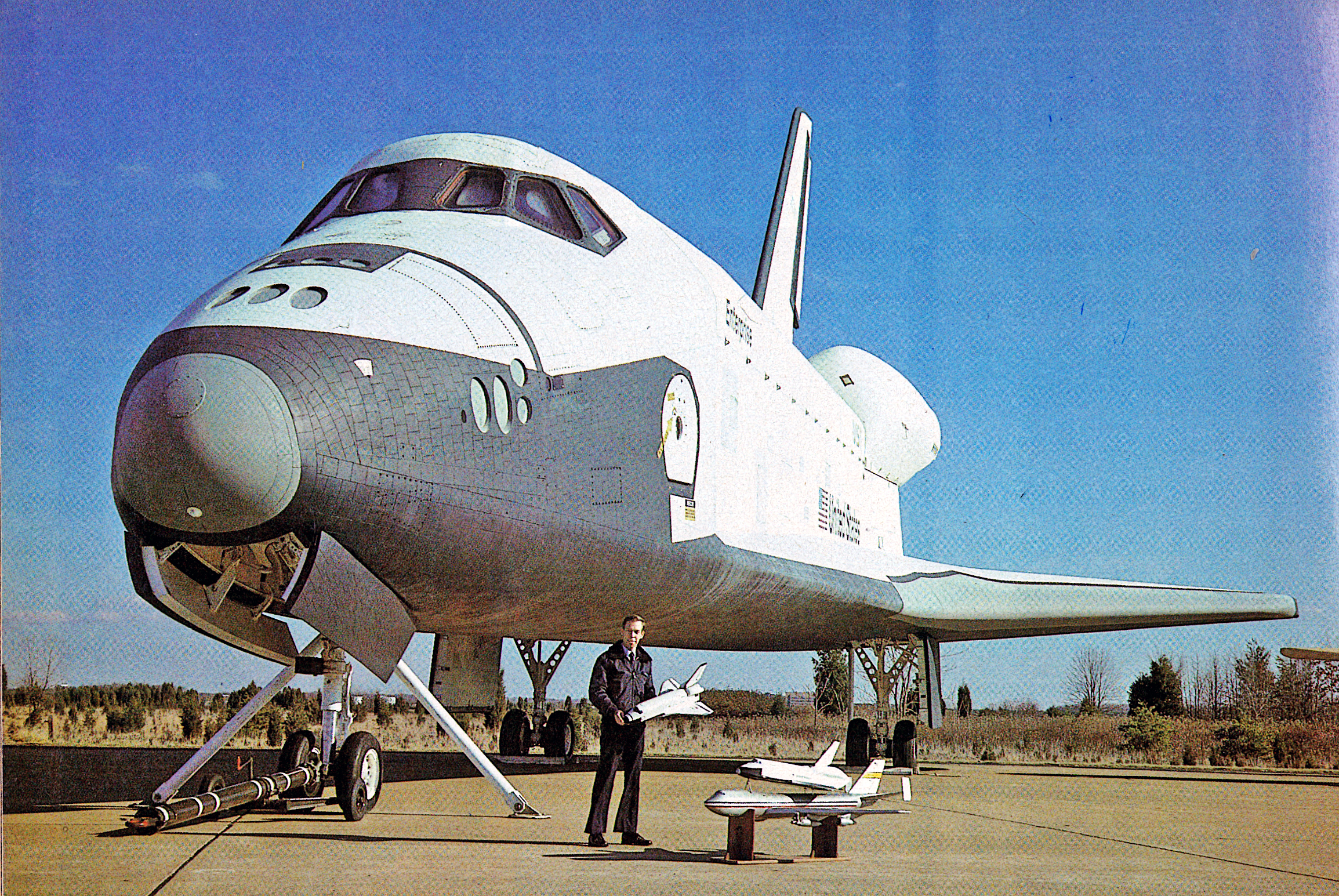
Placing the space shuttle piggyback on the 747 was NASA's answer for the least expensive way to move space shuttles several thousand miles from their landing site back to the launch site. An early question was whether the 747 could be used as an airborne launch pad to test-glide the prototype shuttle, Enterprise (named after the star-ship on the TV series, Star Trek).
The project goal tackled by John Kiker, a NASA engineer at the Houston Spacecraft Center, was to use RC models to create as near to scale as possible the proposed release of the full-size Enterprise. The test was a private venture and not a NASAsponsored project. Most of the equipment was either purchased by John or donated by friends.
The project had great·PR value for NASA, and they were very interested in its outcome. They were also looking at the possibility that the testing might provide valuable input on safely launching the full-scale orbiter from the 747. The exact method of releasing the shuttle was still up for grabs; another idea being considered was to rocket-launch the shuttle away from the 747.
Owen Morris, also a NASA engineer, was asked by John to help with the project. Soon, many local RC club members were also involved. John and Owen were both AMA members and RC pilots.
Construction of the models started in January 1976, and they were flown that summer. One good source for details of the models is the November 1976 Model Airplane News in an article titled “Launching a Space Shuttle.” An earlier April 1976 MAN story was about smaller models than the 1/40-scale ones eventually used.
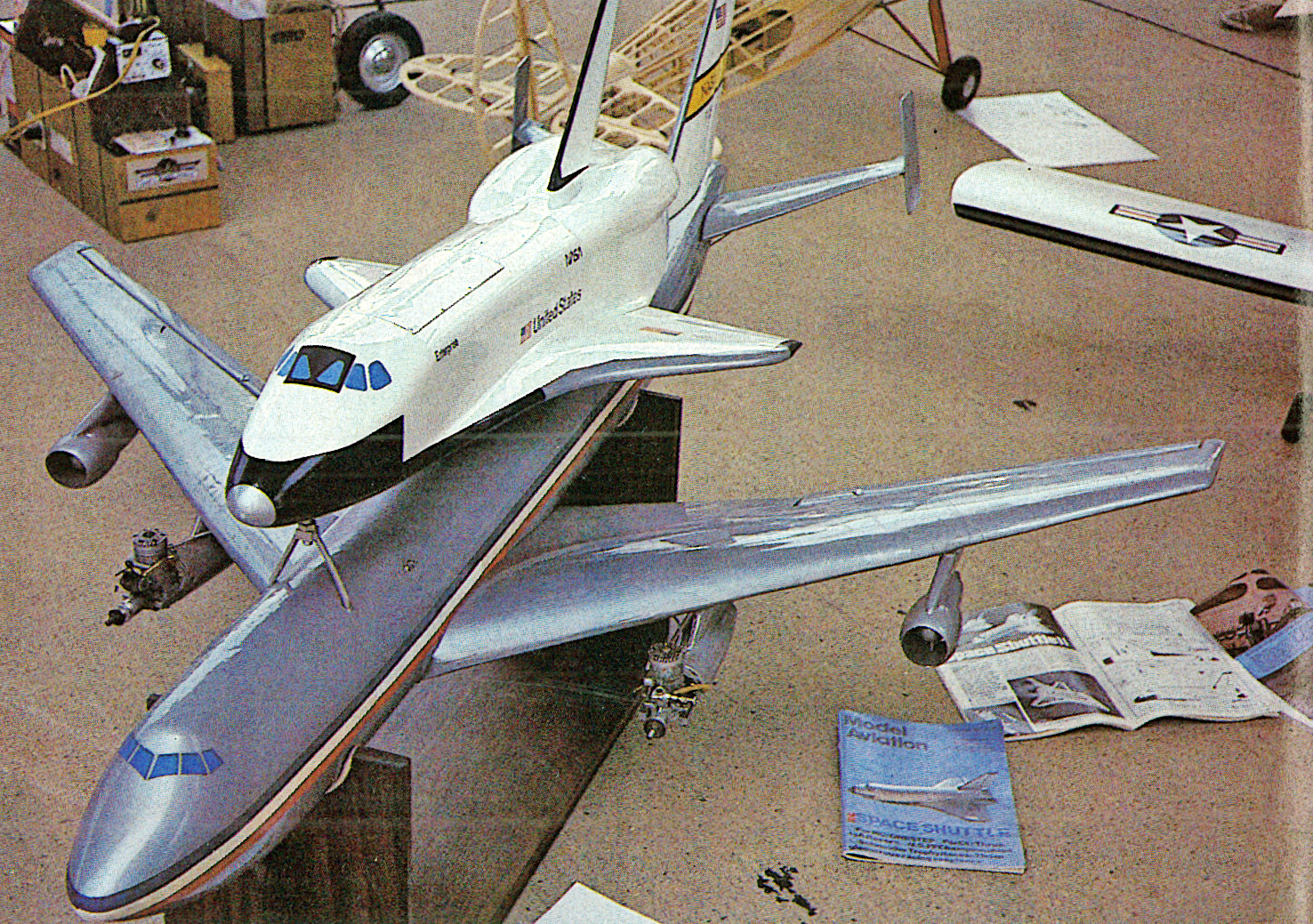
John and Owen provided additional behind-the-story details during phone interviews I had with them. The orbiter models were made from fiberglass using one of NASA’s 1/40-scale test molds. The casting was modified to provide for the radio gear and control surfaces. The models often are thought to be wind-tunnel text models, but John tells me that the originals were used at the Langley towing facility to test for emergency landings in water. Remember that the Cape Kennedy launch site is right on the ocean.
The 747 fuselage, constructed mostly by Owen, was a balsa box covered with foam for shape and fiberglass for strength. The wings, built mostly by John, were sheeted foam cores containing much of the radio gear. K&B donated two K&B .40s with pumps to draw fuel from one tank in the fuselage. They provided ample power for the two heavyweights.
Let me compare their serious shuttle to my own fun shuttle projects (Model Aviation, September 1981 [library.modelaviation.com/article/spaces] and May 1982 [library.modelaviation.com/article/space-shuttle-ii]) to give you an idea of the difficulty they had in launching and flying their shuttle. My funto-fly shuttles of about the same size (242 sq. in.) weigh less than l-1/2 pounds. To match scale weight, their shuttle weighed almost 4 pounds! It's safe to say that these two gentlemen know the meaning of the term "dead stick."
The twin-engined 747 weighed over 11 pounds. Retracts donated by Carl Goldberg Models added to the realism of the 747 and held up well under the 15-plus-pound takeoff load.
There was a problem at first with radio interference between the two models. This was solved by keeping the shuttle's radio turned off until it separated from the 747; a switch triggered on release turned on the shuttle's radio.
Owen was usually the RC captain of the 747 while John was the shuttle's RC commander. On two occasions, the 747 had a one-engine-out condition, but Owen found that it still flew well. One of these instances occurred before the shuttle was launched, and John and Owen chose not to attempt a landing with the shuttle aboard. The resulting launch was tense but successful.
John told me that there were scratches and patches on the way to success. The fast-landing 747 would run out of runway and cartwheel in the weeds, but they were pleased that the models proved to be so durable.
Both models were fast and challenging, as you can see in the AMA film, Those Marvelous Miniatures [youtube.com/watch?v=Mxr8kfqTDYU]. (The space shuttle is not in the shorter promo version.) John assures me that the 4-pound orbiter did glide, but a look at the film makes me wonder if John isn't a bit generous with the word, glide.
The release method used in the film shows the procedure adopted for the NASA glide tests. Here's a simplified description of the sequence:
After the 747 reaches release altitude, it dives briefly to pick up speed. The 747 then rotates from the dive to a climb and back to a dive in a smooth roller-coaster pattern.
As the two aircraft dive to zero Gs (weightlessness) just past the top of the last arc, the shuttle is released. John described this point in the release as two aircraft flying in very tight formation.
The shuttle is mounted at a higher angle of attack than the 747, which places the orbiter closer to its glide angle than the carrier plane. The 747 is more nose-down than the shuttle at release, so it descends more rapidly; the 747 also goes to a "dirty" configuration to slow down while the shuttle moves ahead. Both aircraft are diving at release but at slightly different angles that will put increasing space between them as they descend.
The shuttle turns to move to one side of the 747. The shuttle cannot sustain its flat, slow glide for very long, but by the time the shuttle drops its nose to begin the blistering glide toward earth, the 747 is safely behind and to one side.
A few seconds later, the shuttle pilot has to deal with a one-shot, high-speed rotation onto the runway. After rotation, the shuttle continues to mush toward the runway at a brisk sink rate. Astronaut "Hoot" Gibson, who flew one of the full-size Enterprise test landings, told me that during rotation the cockpit feels as if it's the center of rotation, the entire shuttle lowering behind him.
Following the successful launch of the full-size Enterprise, John Kiker and Owen Morris received commendations from NASA for their contributions to the program through their use of model aviation. NASA then compensated John for his costs with money from the best-suggestion awards fund.
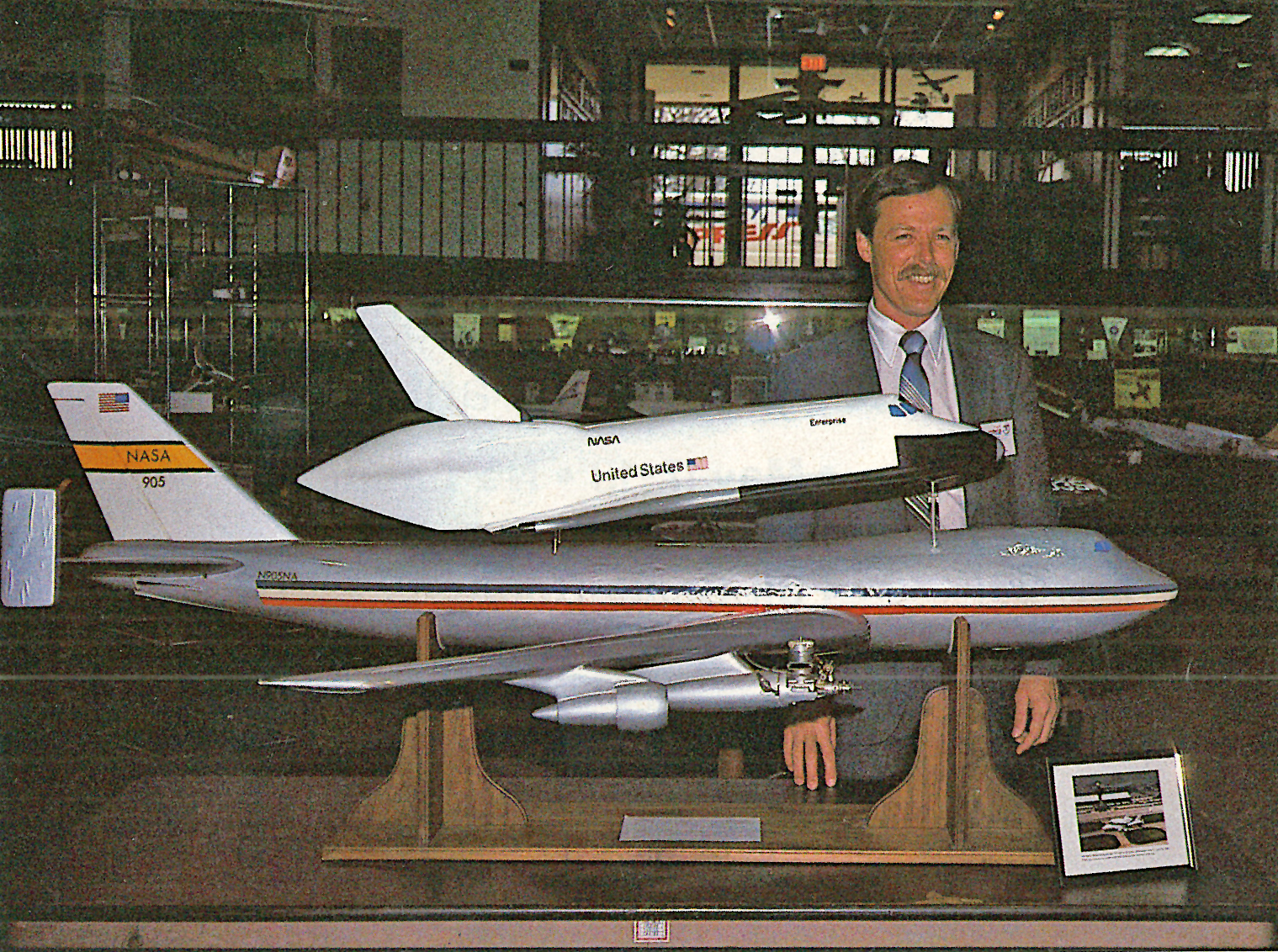
John and Owen had three different shuttle models, which is the reason for the differences in markings seen in the AMA Museum exhibit, the photos in the 1976 MAN, and the AMA film. One shuttle model had landing gear which was µsed for a few flights, but they decided to return to landings in the grass. John still has the other two shuttle models, and he has modified one to test the idea of adding a forward canard control surface.
The earliest test shuttle model was red on the bottom and white on top to aid in orientation. Exact NASA markings hadn't been agreed on then, Later models were the now-traditional black and white for a more scalelike appearance,
The 747 and one shuttle model were donated to the AMA by John Kiker in about 1980, just after his retirement from NASA. They were kept in storage until 1982 when I unboxed them for an exhibit at the Dulles Expo '82. They were placed on display in the newly-completed AMA Museum in the following year.
There's more to the story. John's next model shuttle project was to build a rocket booster. With the help of another NASA engineer, Kirby Hinson, and some input by AMA's model rocketeer, Doug Pratt, he assembled 24 rocket motors and launched the shuttle vertically.
The booster containing the model rocket motors was mounted at the location of the external tank on the full-size one—but with no solid rocket units on the sides, it was not to scale in appearance. Flashbulb ignition was used to assure firing on all 24 motors. "It really worked, and we did it several times," John reported.
He described the result as lots of smoke .and noise—and very impressive. I believe the current term for firing 24 model rockets all at once would be awesome! The rocket booster veered off course only once, but there was enough speed to allow John to correct the problem by using the shuttle's control surfaces. The rocketed model shuttle did not get off the pad as slowly as the manned one. The big shuttle's 3-to-1 lift ratio does not let it accelerate as quickly as a lightweight rocket model.
Where are these men today? Both still live in the Houston area. Each has retired from NASA and is busy working on projects of choice, mostly with full-scale aircraft development and testing. They say they try to fly RC for fun once in a while, but time limits hold them back just as if retirement were another job. However, John still likes to use models anytime he can to test a point without a lot of cost. Owen has been working on a full-size Long-EZE homebuilt for the past several years.
Hoot Gibson, our astronaut visitor to the National Center for Aeromodeling in 1984, is an RC pilot who flies occasionally with John and Owen. Hoot was the pilot of one of the test launches of the full-size Enterprise using the techniques developed by his RC buddies, Hoot was also a chase pilot during many of the Enterprise landings.
My thanks to Hank and Hugh of Dulles Operations for allowing me access for photographing the Enterprise.
Bonus Video


Comments
Error regarding Hoot Gibson flying the Enterprise
There must be a misunderstanding by the author of this article. The sentences under Hoot Gibson's photo as well as in the body of the article say that Hoot flew the Enterprise during its glide tests. This is incorrect from all the data I've researched. There were only 4 astronauts who participated in glide tests conducted during 1977. Hoot was not one of them since he was in the Astronaut Class of 1978 and hired by NASA until January 1978.
Add new comment