
Early proportional—Don Brown’s Quadruplex

You’re ready for another successful day at the flying field. When you move the transmitter sticks, the corresponding control surfaces move precisely and proportionally as you skillfully conclude your flight with a perfect landing—or at least that’s the plan.
We take our current, relatively reliable radio systems for granted, but in the early days of RC, the flying experience wasn’t quite as certain. Our modeling forefathers had to make do with early equipment that bared little resemblance to the present.
Let’s take a look at those early days for a (hopefully) greater appreciation of just how far we’ve progressed in this hobby of ours.
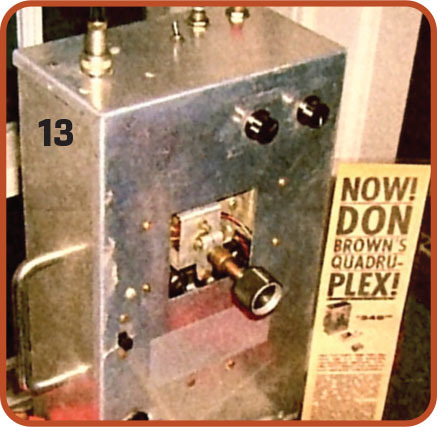
In my September 2021 Model Aviation article about 1962 FAI F3A World Champion Tom Brett’s state-of-the-art RC Aerobatics (Pattern) aircraft, the Cirrus, I briefly touched upon a new type of radio that was first unveiled by Tom’s fellow US team member, Don Brown. Don had hand-built his transmitter and receiver earlier that year in his basement, naming his revolutionary "proportional" radio system the Quadruplex. By the time the FAI F3A World Championship for RC Aerobatic Model Aircraft was over in England, Don’s radio was a major sensation.
In this article, I’d like to expand upon the early history of proportional radios (or simply proportional) and focus on the Quadruplex to see how it fundamentally changed RC flying forever.
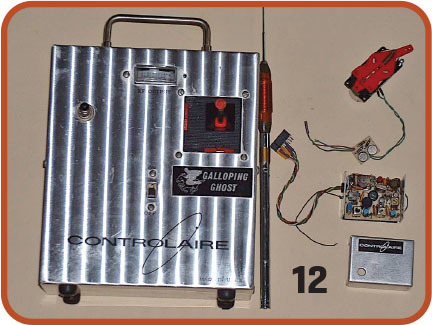
Almost 70 years ago, our RC ancestors flew with primitive escapement or single-channel, rudder-only radios (see "Sources" for details about these systems). Even when everything worked (and it often didn’t), flights were erratic and sometimes barely controllable. Fortunately, with the low-output engines and stable designs that were available, airplanes flew slow enough that there was usually plenty of time to enter the cumbersome push-button inputs that were necessary to keep the model in the air. Performing anything but the simplest of maneuvers was practically impossible. The closest thing to proportional that was available then was something called the Galloping Ghost (more about that later).
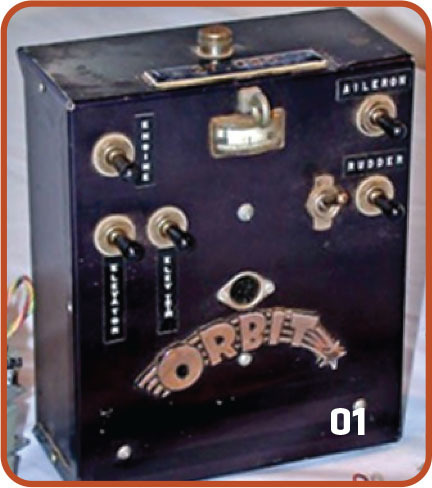
The development of multichannel reed radios (known simply as reeds) in the late 1950s finally made it feasible to control a fast-moving model by means of a series of well-timed toggle-switch "blips," with one toggle switch for each control surface (aileron, elevator, rudder) and one for throttle. With an all-or-nothing servo response, it was definitely a challenge to fly with reeds—especially Aerobatics. It took skill to anticipate the needed input, and then blip the proper toggle switches at the proper time, which allowed for servo lag to effectively guide the path of the model. A loop was performed by holding the toggle switch down and adjusting elevator throw to produce the right size of loop. The same practice was used for performing rolls.
As might be expected, only a relative handful of elite experts could truly master the technique. When US team member Ed Kazmirski won the first F3A World Championship in 1960, all competitors used reeds, but RC was at the threshold of a technical revolution.
In 1962, proportional was a novelty when it was first introduced into a reed-dominated market. It was unproven and problematic. Although it would ultimately replace reeds, proportional was at first openly mocked by some prominent RC personalities; it wasn’t the obvious heir-apparent to the status quo. Detractors couldn’t imagine that in just three years, at the 1965 Nats (with the phenomenal advancement of the modeling industry), 75% of the entrants would be using proportional systems from multiple manufacturers.
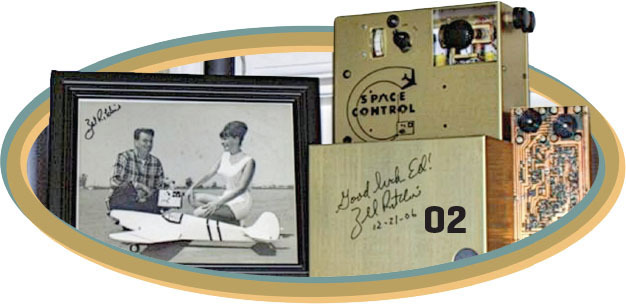
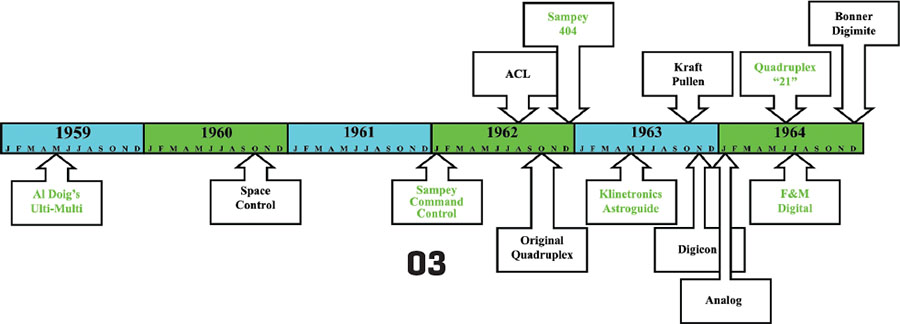
As shown in the timeline diagram, the Don Brown (Dee Bee) Quadruplex wasn’t the first proportional system to be unveiled; the Sampey Command Control and Space Control feedback systems had been announced earlier. Anticipating the importance of the international competitions, Don purposely delayed the release of his system by a few months, hoping for positive, free publicity. His decision paid off.
Early in the competition, Don was in first place with a commanding lead before engine trouble lowered his overall score in later rounds. Ignoring his setbacks, the modeling elite were impressed with his proportional system and respectable fifth-place finish. Once it was on the market, Don’s Quadruplex produced greater initial sales than what his major competitors did combined.
As the eventual 1962 F3A World Champion, Tom Brett was persuaded to design his futuristic Cirrus around the Quadruplex. Using an early production model, plus the newly developed deBolt retractable landing gear, the Cirrus was ahead of its time and a main attraction at the annual Toledo trade show in early 1963.
Tom continued to test the system through the 1963 and 1964 seasons, but, unfortunately, he personally found the media-acclaimed reliability of the Quadruplex elusive. He experienced chronic radio failures that required returns and replacements. Finally, after two major crashes and frustration, he returned to his familiar, trusty reed radio.
Despite that negative experience, the general RC trend after the 1962 World Championship toward proportional was firmly set.
Overview of Vintage Proportional Radios and the Quadruplex
My knowledge of the inner workings of proportional is rudimentary at best; I’ll leave detailed explanations to others with electronics expertise. I can say, however, that different manufacturers developed competing operating systems for proportional, but only one would eventually prevail.
Don’s Quadruplex was essentially a more refined version of the early Galloping Ghost type of pulse control (picture all control surfaces "at rest" and continually gyrating up and down or side to side at full travel). When giving commands, the fluttering control surfaces would speed up while going only part way, providing controlled flight. Surfaces would immediately start wriggling as soon as the system was turned on, which was a negative in terms of battery drain—but it worked! Surprisingly, while looking bizarre on the ground, the wild gyrations didn’t affect the smoothness of the airplane once it was airborne.
The unintended result of the Galloping Ghost system, however, was the inevitable snarky comments at the field from "flying buddies," who would jokingly compare the airplane to a wounded duck. Comments such as, "Don’t touch it—it ain’t dead yet," or "Shoot it and put it out of its misery" were part of the ownership experience. Although it might have worked, the Galloping Ghost simply wasn’t accepted by many as truly proportional, especially as competing systems improved.
Don’s Quadruplex displayed much less movement— more like an exaggerated tremor—but it was still there.
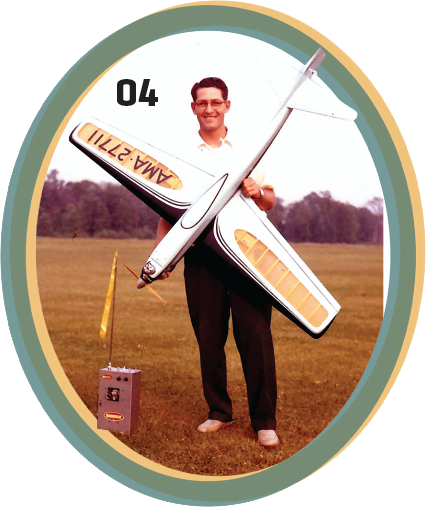
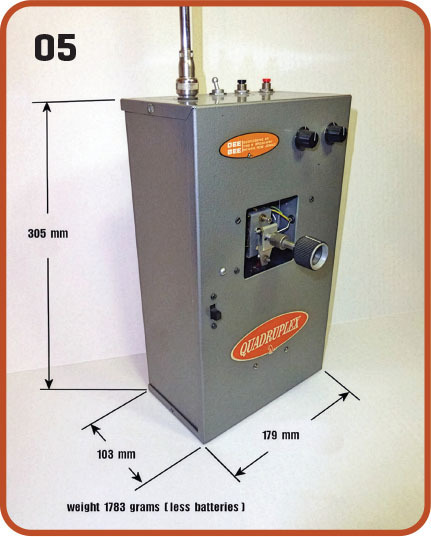
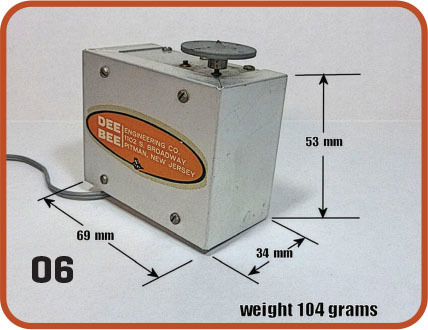
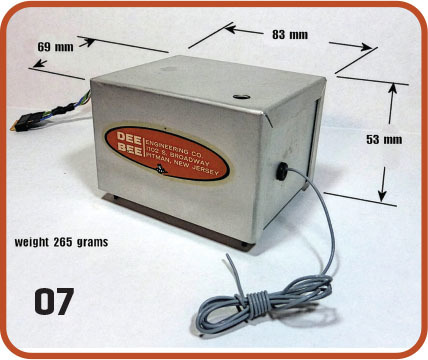
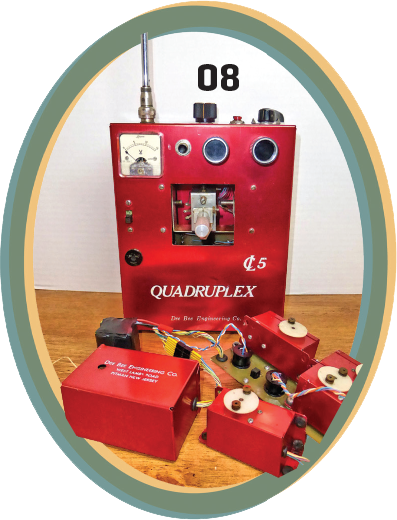
Supporters would point to its proven reliability, lower airborne weight, and a somewhat lower cost than competing feedback systems. Although it was initially true, competitors’ radios kept improving, while Don was constantly being reminded that control-surface jitters, no matter how small, were a distinct negative. The early Quadruplex was also large, bulky, and heavy—the transmitter itself weighed 6-1/2 pounds!
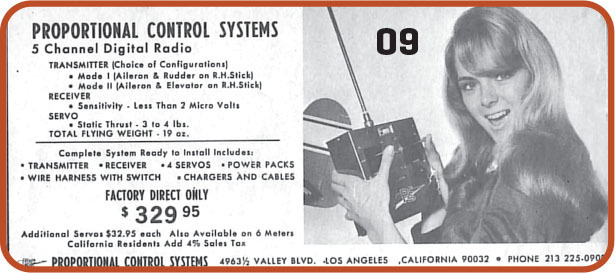
Within months, other manufacturers (mostly from California) expanded the market with their competing systems. It became increasingly clear that proportional was the future of RC. Competitors offered both single-and dual-stick transmitters, not knowing which camp would ultimately prove to be most popular.
Over time, single-stick transmitters were slowly phased out based on sales, but some fliers still preferred them. Digital radios slowly replaced less-precise analog systems as proportional evolved. The Galloping Ghost and reeds continued to be offered as relatively low-price entry options, but they were eventually phased out by the late 1960s as proportional became commonplace.
Despite its high cost of $3,000 to $5,000 in today’s dollars, proportional promised dramatically improved cutting-edge technology and was sold as a complete PNP unit that included the transmitter, receiver, and four servos. The famous Pattern competitors were the first to transition, with the average modeler eventually following their lead.
Phil Kraft, the winner of both the F3A Worlds and RC Aerobatics Nats in the mid-1960s and the designer of many popular models such as the Kwik-Fli, already manufactured quality reed radios. He soon transitioned to a high-end line of proportional radios.
Orbit, with its familiar black case, had been a leading manufacturer since the late 1950s and was considered to be the cream of radios by those who were willing and able to pony up the extra$100 to $200 (equivalent to $1,000 to 2,000 now) to have that prestige Orbit nameplate. Orbit’s $599 price tag would be equivalent to more than $5,000 now.
Duane Wilson took this short video clip of the control actuators on a Galloping Ghost at a Southeastern Model Show in Perry, Georgia. https://youtube.com/shorts/iTUE_73pPv4?feature=share
Continuing the Quadruplex story, in 1965, Don finally introduced a totally new version, the Model CL5. It looked great, abandoned pulse technology, and addressed many of the perceived negatives of earlier models, including the servo jitter. It was well received by the modeling magazines. Unfortunately, by making these changes, the CL5 lost both the cost and airborne weight advantages it previously had over the competition, plus it was only offered in a single-stick version at a time when two-stick radios were on the rise.
Meanwhile, the competing West Coast products from Kraft, Orbit, and PCS made an already highly competitive market nearly impossible to cope with. The practical end for several manufacturers came in 1967, when PCS released a lower-cost feedback system for only$299, ($2,800 in today’s dollars).
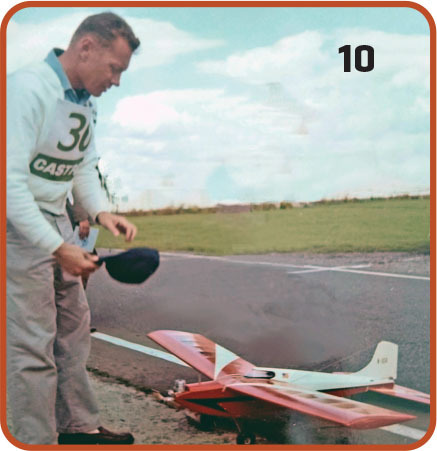
Even though Maynard Hill set both distance and speed world records with a Quadruplex, Don decided that it was time to leave radio manufacturing; however, he continued to service established customers. Always the trendsetter, he later helped pioneer the modern ARF airplane market that dominates today.
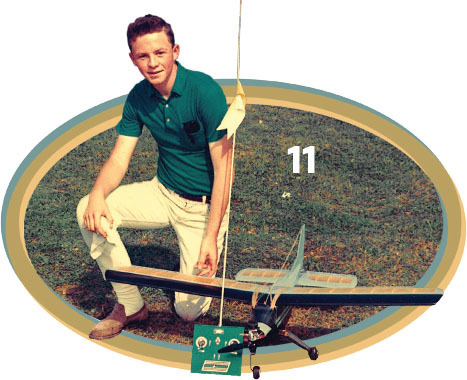
As time passed, other original trailblazing US innovators ultimately succumbed one by one to intense overseas price competition. Overseas manufacturers increased quality while adding new technology features as their prices continued to drop.
Conclusion
Our modern, computerized 2.4 GHz radios make things easy for us. Even the basic radios of today are truly modern marvels; we enjoy better, more-reliable radio systems than what modelers in the past ever dreamed of, and at an affordable price. Try to imagine proportional withoutits most basic features, such as servo-reversing, adjustable travel, dual rates, exponential, and mixing. Early proportional was absolutely bare bones.
Radio installation and setup were much more challenging, necessitating exact servo placement and precise mechanical linkages for servo direction and control throws. There were no model memories, talking transmitters, telemetry, or our state-of-the-art flight aids—they didn’t even have digital trim. We take all of these for granted today, but 60 years ago, these high-tech niceties were all science fiction. Nevertheless, our modeling forefathers were thrilledwith those early systems and were willing to pay a lot for them (in 1960s dollars); proportional was so much easier, more intuitive, and more fun to fly than reeds!
Originally a luxury for a relative few, once prices moderated, RC participation grew by leaps and bounds and the rest, as they say, is history.
I hope you have enjoyed this trip back to RC yesteryear. My sincere thanks to Tom Mavracic, Helen Brett, Dieter Hornig, and the R/C Hall of Fame for their invaluable help with the documentation for this article.
Happy flying!
SOURCES:
"Cirrus: Pushing the Pattern airplane envelope"
Model Aviation, September 2021
Vintage RC Files


Comments
Add new comment