Photos by the author
One of the key items for any aeromodeler’s workbench or field box is a battery charger. Modern chargers are extremely capable and versatile electronic devices. Unfortunately, shopping for a charger can be very confusing to anyone who is not up to speed with all of the latest technology and the associated lingo.
We tend to associate discussions about chargers only with electric-powered models. It’s true that electric fliers probably have the longest list of needs from a charger; however, all RC aircraft use at least one battery of some sort. The suggestions in this article can apply to those of us who fly models with electric, glow, gas, or turbine propulsion systems—and let’s not forget the glider contingent! No matter what you fly, having the right charger can have a big impact on your flying experience.
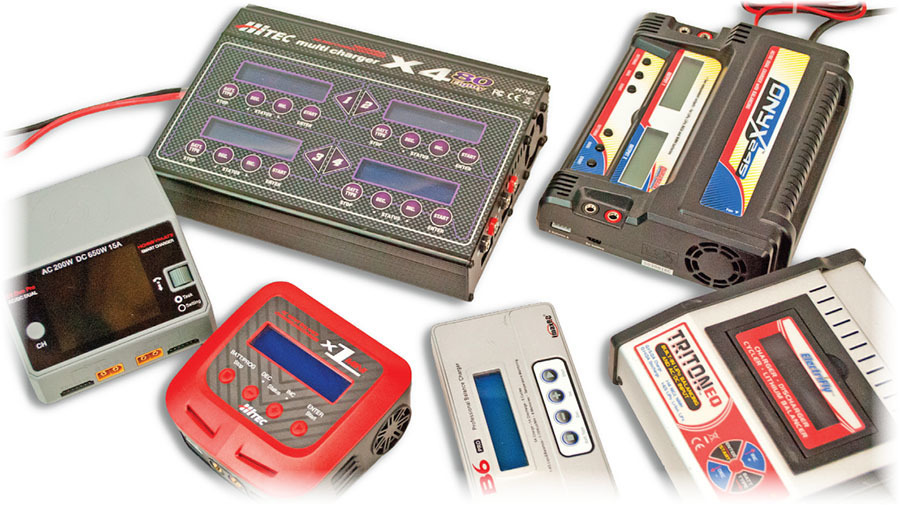
Do not let the variety and complexity of chargers on today’s market intimidate you. Asking yourself a few simple questions about what and how you fly will allow you to determine your charging needs. You can then focus your search and find the perfect charger.
What Types of Batteries Do I Use?
Most modern chargers are capable of charging several different kinds of batteries, including nickel-cadmium (NiCd), nickel-metal hydride (NiMH), and lithium-polymer (LiPo). That is an extremely useful feature because we utilize many different battery chemistries within the hobby. Do not assume, however, that any multi-chemistry charger can handle all of your battery types.
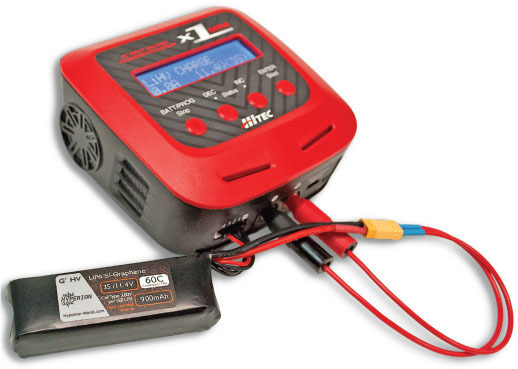
I recently had to buy a new charger because none of my older units were capable of charging lithium-polymer high-voltage (LiHV) cells. Perhaps you use a field box with a lead-acid (Pb) battery, or maybe the onboard radio system in your Giant Scale gasser is powered by a lithium-iron phosphate (LiFe) pack. What kind of battery is in your glow plug igniter, your electric starter, or radio transmitter? Take stock of every different battery you use and seek out a charger that can handle them all.
Are You Smart?
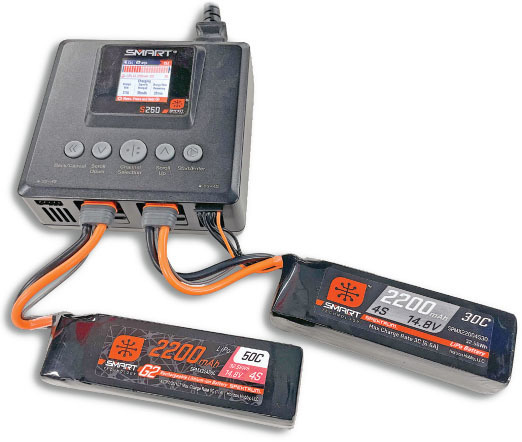
Most brands of batteries and chargers can be used interchangeably with no issues. One exception is the Smart series of batteries and chargers offered by Spektrum. The Smart batteries have a built-in microchip that provides features such as saved charging parameters, health status, and automatic discharging to storage voltage. Several of the features unique to Smart batteries are only viable if you use a proprietary Smart charger. There are several from which to choose.
While the Smart chargers are capable of charging non-Smart batteries, the reverse is not always true. For instance, the Generation 2 (G2) Smart batteries can only be charged on Smart chargers.
Here’s the bottom line: If you have decided to use Smart batteries, it only makes sense to choose a Smart charger as well.
How Many Cells Can I Charge?
Many modern chargers can handle lithium-based batteries with up to six cells in series (typically noted as 6S), which is plenty for most applications. A wide range of models fly on batteries with six cells or less. Even high-voltage applications do not necessarily use a single battery pack. For example, a large EDF model that requires a 10S LiPo battery can also be powered with two 5S batteries in series. In that case, a charger capable of handling 5S batteries will work just fine for you.
Modelers who enjoy ultramicro models should also pay close attention to the cell-count limits of a potential charger. Some chargers have a two-cell minimum for lithium batteries. Such chargers are useless for the single-cell LiPo batteries found in many ultramicro aircraft.
How Quickly Can I Charge?
I’m a bit old school regarding my LiPo batteries. I like to use a 1-hour charge rate (1C) most of the time. This means that I will charge a 2,200 mAh battery at 2,200 mA (2.2 amps). Likewise, I will normally charge a 5,000 mAh battery at 5 amps. Some newer LiPo batteries, however, can be safely charged in as little as 12 minutes (at a 5C rate) or faster! Just be sure to verify the maximum charge rate of any battery before attempting a fast charge. You should also keep in mind that repeated fast-charging could shorten the overall lifespan of your batteries.
Having batteries that can handle a quick charge is only one part of the equation. You must also have a charger that will dish out the amps. Take note of a charger’s maximum charge current and the capacity of a given battery.
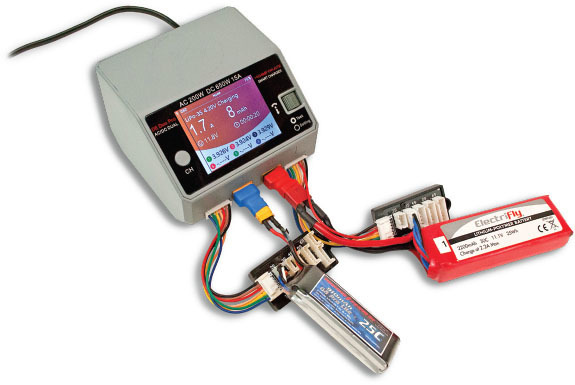
Let’s say that you want the ability to charge a three-cell 2,200 mAh LiPo battery in 20 minutes (a 3C rate). This would require a charger with a maximum charge rate of at least 6.6 amps (2,200mA [2.2 amps] x 3 = 6.6 amps). Similarly, a four-cell 4,000 mAh LiPo would require 12 amps to charge in 20 minutes.
When you are looking at a charger’s specifications, be sure to note the maximum output power (watts). The power limit is a function of the charging current multiplied by the battery’s voltage. For instance, a charger with an output capacity of 100 watts can be used to charge a three-cell LiPo battery at up to 8 amps (12.6 volts x 8 amps = 100.8 watts). That same charger can charge a six-cell battery at only 4 amps (25.2 volts x 4 amps =100.8 watts). If you intend to fast-charge LiPo batteries that have more than three cells, do the math and make sure that your selected charger can output enough power.
What Are My Power Sources?
Some chargers require a DC power source, such as a car battery or an external DC power supply. Other chargers plug right into an AC power outlet. There are also chargers that will accept either AC or DC input power. When deciding which type will fit your needs best, you should consider the power sources that you have access to at home and at the field.
Even if you charge primarily at home, it is wise to consider what kind of power is available when you fly. You will likely want to skip any AC-only chargers if your flying field is off the power grid. Some clubs provide a 12-volt DC source via solar-powered energy storage systems. With these, you can use a DC charger at the field without having to power it with your car battery. Some of those solar systems include inverters to provide AC power as well.
AC and AC/DC chargers are very convenient for those who do have access to AC power, but be aware that the built-in power supply of these types of chargers can limit their charging capabilities. You will likely find that the maximum charging power for an AC/DC charger is significantly lower when using AC input power.
For example, the Hitec RDX2 800 is a two-port charger that can output 200 watts per charging port when take the built-in power supply is used with an AC power source. That same charger can output up to 400 watts per charging port when takeout a DC source is used for input power. You will just have to make sure that the power source you choose is up to the task. For my home charging setup, I use a DC charger powered by a 12-volt, 50-amp power supply.
How Many Charging Ports Do I Need?
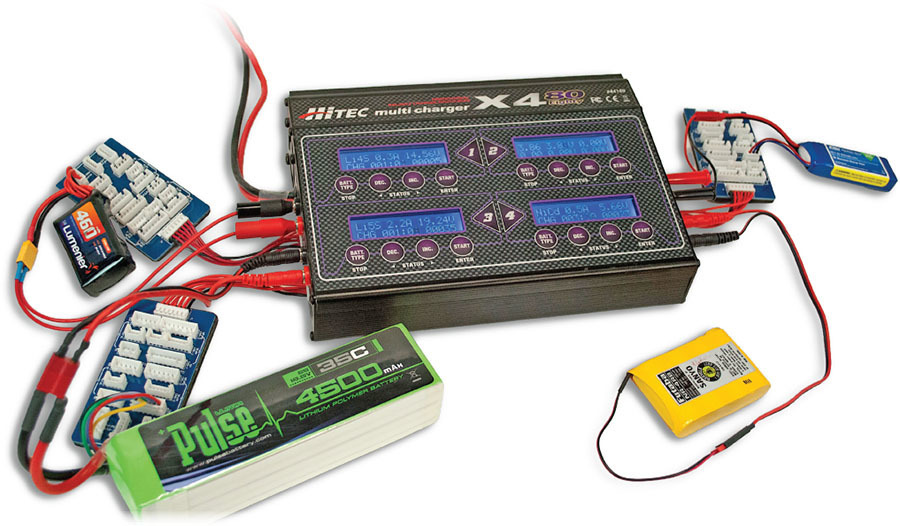
I like to charge all of the batteries I need for an outing just before I head to the flying field. Several of my buddies prefer to charge at the field. In both cases, a multiport charger can be a real time saver.
My primary charger has four charging ports. This allows me to charge four separate batteries at the same time, each with a dedicated charging circuit. This is different from parallel charging, where multiple batteries are charged concurrently on the same circuit (a practice I do not personally recommend).
A four-port charger like mine is probably overkill for many modelers. Two ports might do the trick for you, or perhaps you only need one port. It all boils down to how many batteries you want to charge at once.
Now Dig Deeper
If you have worked through the questions above, your field of potential chargers should have narrowed considerably. Now it’s time to examine each of the remaining candidates in more detail and make a decision.
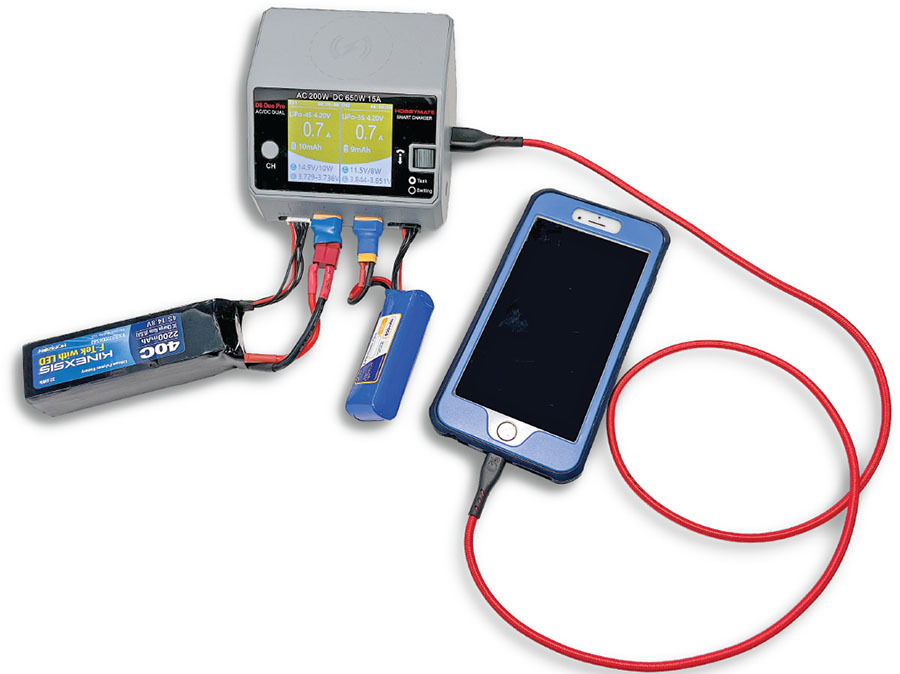
Factors such as physical size and shape might come into play. You should also look at the extra features that are found on newer chargers. Some have USB ports and wireless charging capabilities for your phone and other devices. There are even chargers that allow you to monitor the charging process through your phone. Of course, there is always the price to consider. Don’t forget to also pick up any charge leads and balance adapters you might need.
Happy shopping and safe charging!
SOURCES:
Spektrum




Comments
Add new comment