Free Flight Sport
By Don DeLoach | ddeloach@comcast.net
As seen in the August 2025 issue of Model Aviation.
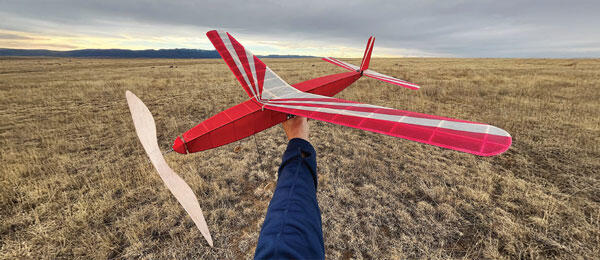
A LOT OF FOLKS talk about the "Golden Age" of Free Flight (FF) being long since passed, but there’s plenty of evidence to the contrary. Just the small area of coverings for our models has evolved into a wonderful, specialized selection of choices.
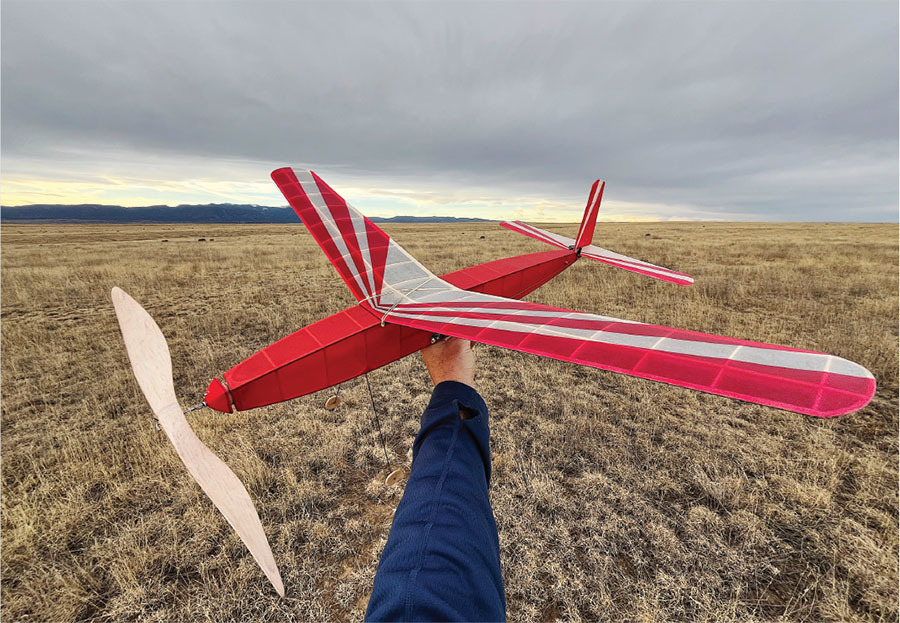
The following is a brief rundown of the most popular coverings for FF.
Iron-On Synthetics
- UltraCote Lite: 36 grams per square meter (GSM). This polyester film covering is fuel proof and waterproof. The heat-activated adhesive is already on it. Durable, stable, and long lasting, it’s a favorite of FF glow-engine fliers for models that are approximately 6 ounces and heavier. UltraCote comes on a 23.5-inch × 2-meter roll in a variety of colors. It adds a fair amount of torsional (skin) strength.
- Doculam: 14 to 38 GSM. Available in 1.6-mil and 0.6-mil thicknesses, Doculam is one of the easiest-to-use self-adhesive, fuel-proof coverings. It offers an almost infinite shrink range, is light weight, and is inexpensive. It can be painted lightly on the adhesive side to produce semitransparent colors. The downsides are that it only comes in one color and that it does not add much torsional strength to surfaces.
- Mylar: 6.8 to 20 GSM. Mylar, also known as biaxially-oriented polyethlene terephthalate (PET) or BoPET, is a polyester film made from stretched PET and is used for its high tensile strength, chemical and dimensional stability, transparency, reflectivity, gas and aroma barrier properties, electrical insulation … and as model aircraft covering. BoPET film was developed in the mid-1950s, originally by DuPont, Imperial Chemical Industries, and Hoechst. Mylar is a registered trademark of the DuPont Teijin Corporation.
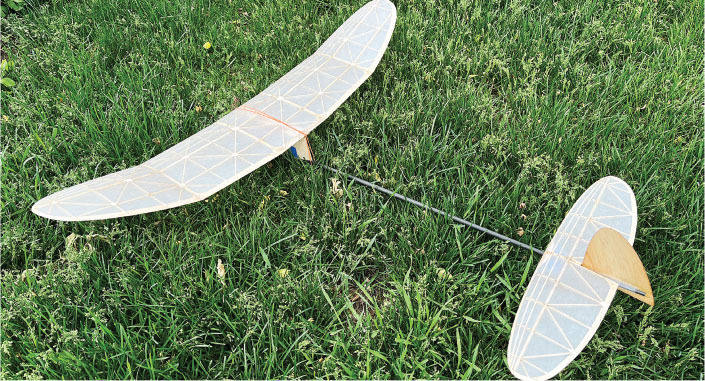
A large range of Mylar films is available for use on both Indoor and Outdoor models in clear or chrome/aluminized. The aluminization is at the molecular level—there is no weight penalty.
Mylar Table of Densities
- 5 micron: 1/4-mil, 6.8 GSM
- 7.5 micron: 3/8-mil, 10.2 GSM
- 10 micron: 1/2-mil, 13.6 GSM
- 12.5 micron: 3/4-mil, 20.4 GSM
The advantages of Mylar are numerous. It is fuel proof, waterproof, and stiff enough to produce a bit of torsional strength. It is very lightweight, but it requires heat-activated adhesive brushed on the frame before covering. This saves weight but costs a bit more time.
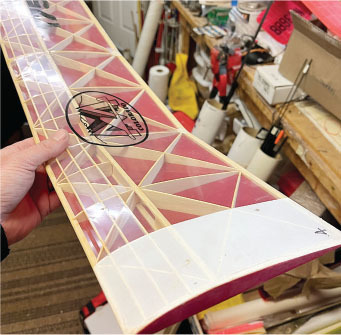
The disadvantages are that Mylar only comes in clear or chrome and the lighter densities are easily punctured by cacti, bushes, etc. It is easily repaired, however, with Scotch tape.
- Polyester Tissue: 20 GSM. Sold in the US as Polyspan, polyester tissue is very tough and must be adhered with dope or other adhesive, much like tissue. Similar to iron-on film, it shrinks with heat, not water; any creases can be removed with an iron during the covering process. It’s very tough stuff and will last for years on a structure. I have several well-used models that were built from 2003 to 2007 with their original Polyspan covering.
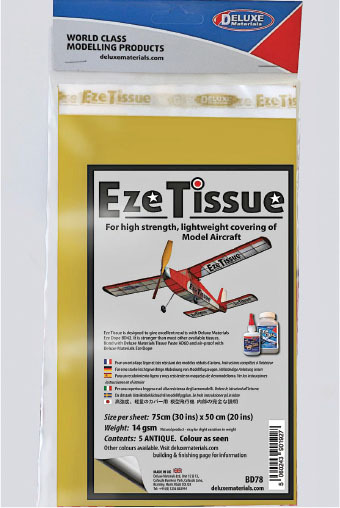
- Eze Tissue: 12.5 to 14 GSM. A specially developed lightweight tissue from Deluxe Materials that is ideal for lightweight balsa aircraft, Eze Tissue is superior to many other tissues. The paper is designed to be bonded with Deluxe Materials Tissue Paste AD60 and subsequently airproofed with multiple coats of Deluxe Materials Eze Dope BD42. It’s supplied in 75cm × 50cm sheets and a range of colors.
Natural Fiber Tissues
- Esaki tissue: 12 GSM. This very high-quality tissue was made in Japan by the Esaki Company. The traditional covering for FF models since the 1930s, Esaki tissue is still revered for its combination of light weight and very high skin strength/torsional resistance. Simply put, no material is better overall for FF models in the 10- to 45-inch wingspan range and weights up to about 5 ounces, but there are some significant downsides.
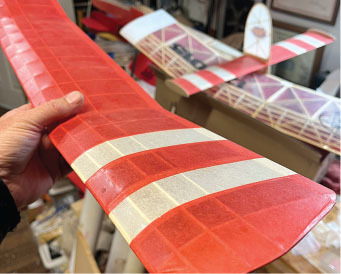
Esaki requires adhesive, such as dope or white glue, then a brushed-on or sprayed-on pore-filling finish. It is very sensitive to humidity, so when it is damp, it goes limp, which can make flying your model impossible. It is not long lasting—Esaki-covered models tend to need recovering within five years.
Esaki is now out of production, but it can be found occasionally from suppliers or in the aftermarket.
- Asuka tissue: 14 GSM. After considerable searching and correspondence, a new tissue to replace Esaki has been developed. This tissue is almost identical to Esaki in both weight and texture. Sheets are 18 × 24 inches. It’s available in blue, red, orange, yellow, and white.
-
Domestic tissue: 16 to 18 GSM. The domestic tissue marketed by Peck-Polymers/Wind-it-up Enterprises is lightweight, inexpensive, and made in the USA. Peck offers 25 colors, including metallic silver.
The company has added colors to the line that will work well for Scale models, together with some bright new colors for Sport models and creative model builders. Sheets are now 15 × 20 inches, which makes them easier to handle. Peck-Polymers tissue averages 3.0 to 3.5 grams per sheet.
- Kuranai tissue: 9 GSM. One of the lightest tissues available, Kuranai is 30% lighter than Esaki. It’s great for lightweight Indoor, tissue-covered models, Embryo, Peanut Scale, etc. It has a very soft texture and a pure white color. It’s not for Outdoor models, except for maybe tail feathers and very lightweight and small Scale models.
Indoor Model Coverings
-
Condenser paper: 8.8 GSM. Similar to tissue paper, condenser paper is affected by moisture, so it should not be applied tightly on a flimsy balsa frame. Leave a little slack to prevent it from warping the frame. This is a great choice for Easy B and similar Indoor contest models.
It is best applied using permanent glue stick or thinned white glue, but it can also be applied with contact cement. Using a brand-new razor blade, trim condenser paper along the edge of the balsa frame. A straight edge can be helpful along straight leading edges and trailing edges.
-
UltraFilm: 1.4 GSM. UltraFilm is a special polyester Mylar film that is manufactured by DuPont. It is 1.4 micron thick and weighs approximately 128mg per 100 sq. in.
This is the perfect film for covering Science Olympiad models, Limited Pennyplanes, etc. It’s stronger and more forgiving than OS7 Film.
-
OS7 Film: 0.7 GSM. OS7 Film is the lightest covering that is available today. It is also a special polyester Mylar film that is manufactured by DuPont. It is 0.68 micron thin and weighs approximately .065 grams per 100 sq. in.
OS7 Film should not be used for Science Olympiad. This film is very lightweight and fragile. It is only appropriate for the very lightest and slowest Indoor Duration models that weigh 1 gram or less.
SOURCES:
National Free Flight Society (NFFS)
J&H Aerospace
FAI Model Supply
440-930-2114
Indoor Free Flight Supply
Retro RC LLC
(248) 212-9666
Peck-Polymers/Wind-it-up Enterprises
Volaré Products
(269) 339-9795
BMJR Models
(321) 537-1159
Deluxe Materials
Design Master
(800) 525-2644
DuPont


Comments
Add new comment