
FOR MUCH OF human history, glue was available only to a small percentage of the population (nobles, woodworkers, etc.). The earliest known adhesives came from the bark of birch trees and were used in prehistoric times 200,000 years ago. The more common "animal hide" glue was first introduced in ancient Egypt approximately 4,000 years ago.
The most popular uses of glue, which was very expensive and rare at that time, were reinforcing the durability of papyrus scrolls and creating furniture. Several examples of such furniture were preserved in the tombs of Egyptian pharaohs.
The model airplane hobby simply could not exist without glues. As a basic building component, glues have been around longer than balsa wood. The first model aircraft in the late 1800s were made with hardwood, wire, paper, and glue.
Aliphatic Wood Glue
Aliphatic (yellow) woodworking glue, also known as aliphatic resin or carpenter’s glue, is ideal for general construction in balsa models. It is known for its strong bonding properties and faster drying times. It is non-toxic, paintable, and stainable. It doesn’t expand as it dries, and it also dries to a semitransparent yellow, making it suitable for natural and light-stained woods such as balsa. Aliphatic glue can easily be cleaned up with soap and water when it’s wet and can be sanded when it’s dry.
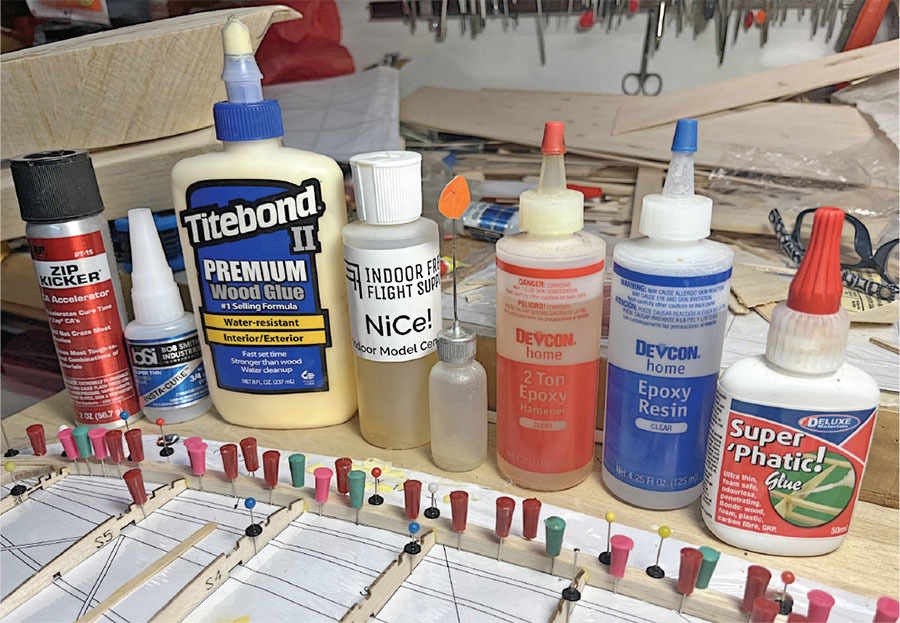
Common brands include Elmer’s Carpenter’s Yellow Wood Glue and Titebond Yellow Wood Adhesive. Both are known for their strong initial tack and excellent sandability. Titebond II is a top choice for our purposes because it is also waterproof.
The only drawback of yellow wood glue is that you have to wait hours until it reaches near-full strength. The general rule of thumb is 24 hours for full strength.
Nitrocellulose Glues
Blending some of the best attributes of other glues, nitrocellulose "solvent" glue is a classic modeling adhesive. It dries fast (in approximately 5 minutes), it’s clear, and it’s very lightweight because of its significant evaporation rate. It is excellent for most general construction in Free Flight (FF), in particular for smaller and lighter weight models such as Rubber Scale. The joint is not quite as strong as epoxy (nothing is), but it is much lighter and not too brittle.
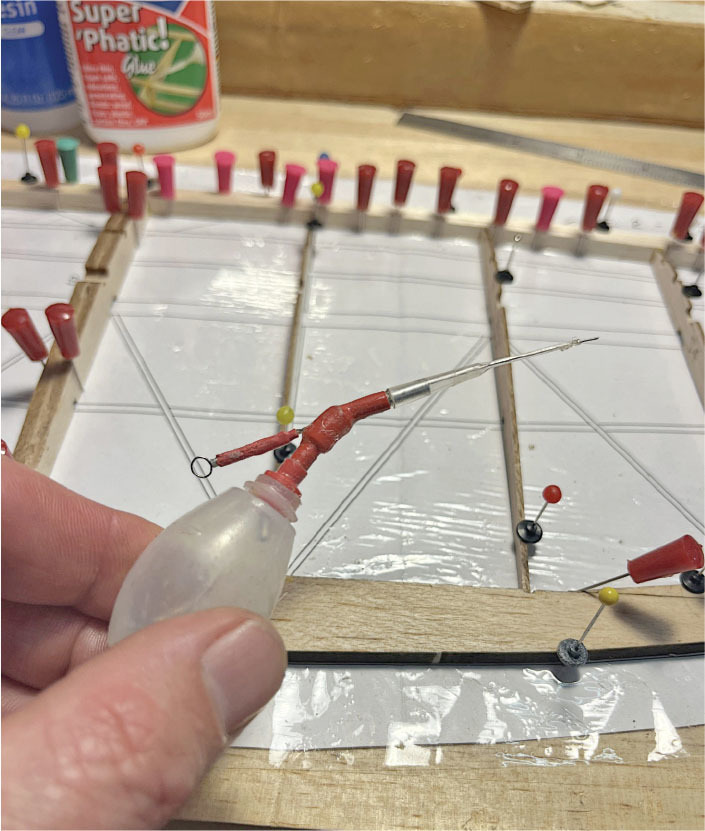
For Indoor FF Duration models, nitrocellulose glue is used almost exclusively because of its light weight. It is commonly thinned with acetone by approximately 50% and can be applied with a fine-tipped applicator bottle. The best applicator is the hand-made Micro Cementeur that is available through Indoor Free Flight Supply.
Old-timers will remember Ambroid and Duco, two of the oldest brands. Duco is still available at retail outlets such as Ace Hardware, but Ambroid is no longer produced. Indoor Model Supply’s NiCe! Indoor Model Cement is newly available and is superior because of its not-too-extreme shrinkage rate.
The drawbacks of nitrocellulose are few but significant. It is chemically toxic, with significant volatile organic compounds, so use it only in a well-ventilated area or with a respirator. It is also highly flammable.
Epoxies
We can thank modern chemistry for the creation of two-part epoxies close to 90 years ago. Epoxy is in the family of basic components or is a cured end product of epoxy resin, also known as polyepoxide, a class of reactive prepolymers and polymers that contain epoxide. In short, a chemical reaction takes place when you mix the two parts, resulting in an extremely strong bond.
All epoxies are non-shrinking and produce very rigid bonds, usually much stronger than the balsa and light plywood that they are joining. Epoxy is also known to do an excellent job of filling poorly mated joints (not all glues excel in this area). Epoxies create powerful bonds with ferrous and non-ferrous metals, ceramics, wood, or glass, in any combination.
In the aerospace industry, epoxy is used as a structural matrix material that is reinforced by fiber. Typical fiber reinforcements include Kevlar, fiberglass, carbon fiber, and boron. Epoxies generally outperform most other resin types in terms of mechanical properties and resistance to environmental degradation.
There are many formulations of epoxy, but for modeling, there are two main types: fast-curing and slow-curing. The fastest is 5-minute epoxy, of which there are many brands readily available in retail stores. It hardens very quickly but is known to be less than ideal for longterm use because of its brittleness. Nevertheless, it’s a good idea to have 5-minute epoxy in your flight kit for emergency field repairs.
A bit slower curing and much better, in my opinion, is Devcon 2 Ton Epoxy. It is excellent for general use in FF. It has an 8- to 12-minute working time and is ready for use in 30 to 35 minutes. Unlike 5-minute epoxy, 2 Ton doesn’t get too brittle and lasts for many years.
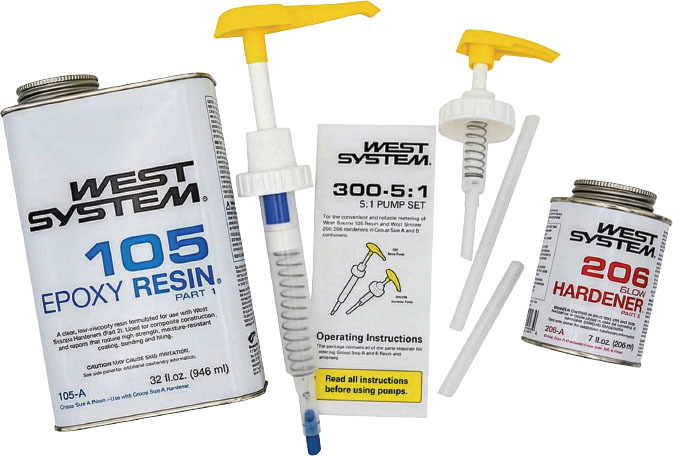
Many serious modelers spend the extra money and opt for commercial-grade epoxies, such as West System. West System is a marine epoxy that is renowned for its strength and longevity under the harshest conditions—cold, heat, UV, and moisture. For a little more than $100, you can get a 39-ounce West System 105 Epoxy Resin and 205 Fast Hardener kit with calibrated dispensing pumps for accurate mixing. This much epoxy will last most modelers a decade plus. West System also makes a new flexible epoxy, G/flex 650 Toughened Epoxy, which is specially formulated for extra flexibility and applications that experience vibration.
While epoxies have huge benefits—and there are situations where they are by far the best choice for model building—they do have drawbacks. In small FF models, the total flying weight and wing loading are critical, so the fact that epoxies are heavy makes their use for general construction inadvisable.

October 4-7, 2026
THE ORLEANS HOTEL LAS VEGAS
ATTEND AS A RETAILER OR EXHIBIT
SIGN UP AS A MEMBER AND RECEIVE A HUGE SHOW DISCOUNT
Contact: Josh Gherman
516-456-3035

Ritzy 20
5F capacitor powered electric
(248) 212-9666
PO Box 193, Keego Harbor, MI 48320
20" span
PU Glue
Polyurethane adhesives (PUs) are known for bonding a wide range of materials, including wood, metal, stone, and plastic. PUs are also fully waterproof, but they expand as they cure, making them undesirable for most model airplane applications. If readers have experience with PUs for FF, I’d love to hear about them.
Instant Glues
Cyanoacrylate (CA) instant glue was invented in 1942 at the Eastman Kodak Company. A chemist was trying to synthesize optically clear plastics for aircraft gunsights. Frustratingly, CA seemed to be promising but stuck to everything they touched.
A form of the adhesive was first sold in 1958 under the name Eastman #910. During the 1960s, Eastman Kodak sold CA to Loctite, which in turn repackaged and distributed it under a different brand name, Loctite Quick Set 404. In 1970, FFers Bill and Bob Hunter brought their Hot Stuff CA to the model airplane hobby, where it was an immediate success. It has maintained a strong following ever since.
CA is generally available in three viscosities: thin, medium, and thick. Generally, the thinner the viscosity, the faster CA cures. For the thinnest CA, it is 1 to 3 seconds. Medium is close to 5 to 10 seconds, but it can be longer if more glue is used.
A key with CA for modeling is that not much is usually needed for a strong bond. Experiment on scrap wood to get to know the unique properties of CA. It is not for children or the inattentive.
The major drawback of CA is toxicity. The fumes can be very irritating just as the glue chemically "kicks." Hold your breath when you see a little puff/bubble on the wood.
Other drawbacks are that CA is relatively brittle and it can add excess weight to a model if too much is used. It can, however, be debonded with CA debonder or plain acetone.
No other adhesive is as fast-curing though, and that alone makes CA indispensable for FF modeling.
SOURCES:
National Free Flight Society (NFFS)
ITW Performance Polymers


Comments
Add new comment