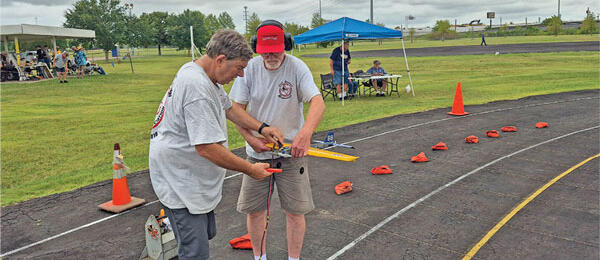
I’M RELATIVELY NEW to electric power, and I continue to learn things I didn’t know–through experience and from listening to others. I’ll relate a couple of them in case you didn’t know about them either.
Motor Timing
Timing of the electrical switching in the ESC is generally somewhere between 5° and 10° and relates to the position of the magnet when the coil is switched on to produce the force that turns the propeller. With normal motor speeds in the range of 10,000 to 18,000 rpm for the vast majority of sport flying, a common default ESC setting of 5° is used by many manufacturers. At higher motor speeds, the timing needs to be higher. Most ESCs can be programmed to adjust the timing and might have an option for selecting it from a numerical option listing or might have settings labeled "Outrunner," "Inrunner," or "EDF," with the latter two being the higher timing settings.
You have a problem if you hear pronounced, random "clicks" occurring two to five times per second. It sounds almost as though you are throwing small pebbles into the propeller. That means that the ESC is having trouble keeping up with higher motor speeds and is occasionally sending out a switching signal that impedes rotation for a very short time, producing the noise you are hearing.
Lucien Miller, the CEO of Innov8tive Designs (BadAss Power Systems), enlightened me on this subject when I called to ask him about it. I hope I’ve done justice to his explanation.
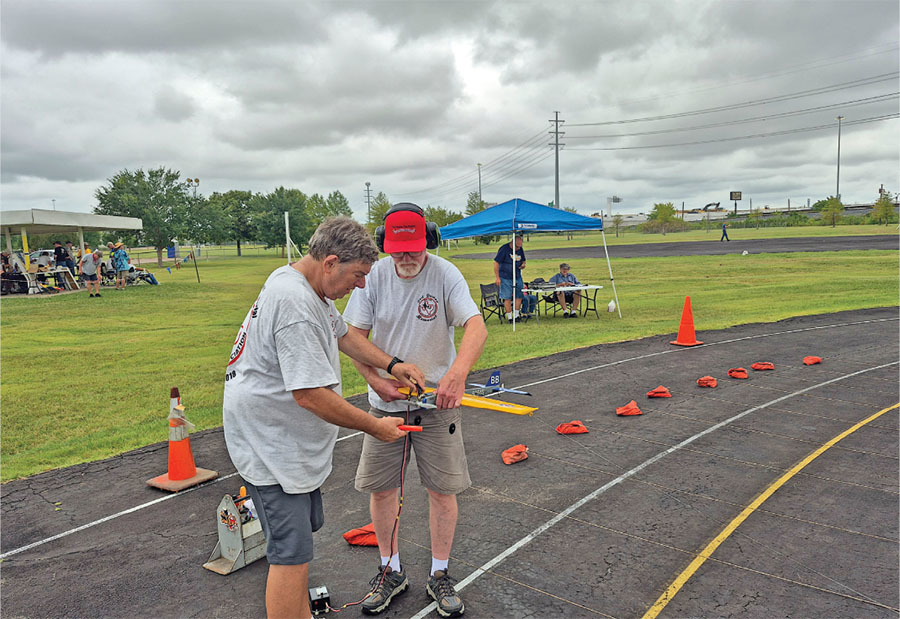
To avoid issues with my Class I/II electric motors turning at close to 29,000 rpm, I changed the timing from 5° to 10° before taking the motors to the high air density of the Nats (I live above a 6,000-foot elevation in Albuquerque, New Mexico). By the way, the BadAss ESCs, according to Lucien, can accommodate motor speeds of up to 40,000 rpm without issue.
It worked great; my motors ran without a single "pop" at a high speed. I was also pleasantly surprised to discover that my speeds were about 1% higher! I was unpleasantly surprised, however, when the motor flamed out just before I crossed the deck on my seventh lap of low speed. The increased timing had also increased the current draw of my motor significantly. In addition, on all flights after the first one, the ESC shut down about 1 second after the model was released. With my current limit set quite high at 150 amps, this was completely unexpected.
Analysis of my ESC data following the Nats showed an increased current of more than 25 amps on high speed and at least 15 amps on slow speed. I was using 1 Ah more of battery capacity than usual—with nominally the same performance. The likely reason my high speed was only slightly higher than previous flights was that the increased current was dropping battery voltage toward the end of the high speed. If you want to adjust timing, do it in small increments.
Resetting the ESC in Flight
I also learned at the Nats that the Castle Creations ESCs can be reset in flight by reducing the throttle fully to off for a few tenths of a second, and then returning to full throttle. Doing so hurt my high speed by 10 mph but let the flight continue. There is no need to remove electrical power from the ESC to reset it after an overcurrent shutdown. It’s a good trick to keep in your hip pocket should you need it.
Seamew Happy Landing
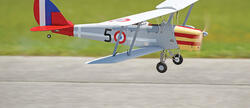
In the December 2023 column, I included photos of a mystery Class I Seamew that I received through Mike Potter and requested information about who had built it. I immediately heard from Bob Paul, who has been active in Control Line (CL) for many years in and around Cleveland, including managing the outstanding CL flying facility for the city of Cleveland until the government decided that it had better use for the land.
Bob had built that Seamew in the 1970s. It was the third one after two prior Seamews were destroyed in unfortunate crashes. It had never been flown. It disappeared during a move and went through a few other hands until it finally ended up with Mike in Oregon. Mike sent the Seamew to me in Albuquerque, and I took it to the 2024 Nats, where Dave Heinzman met me at the Carrier circles and took it back to Ohio for its reunion with Bob. It now resides in its rightful place with Bob after a journey of 20 years and a few thousand miles.
Onboard Voltage Monitoring
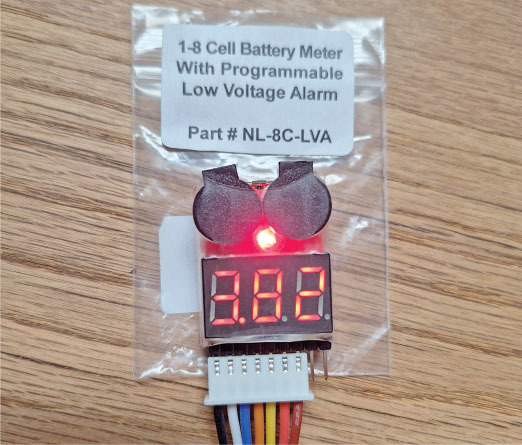
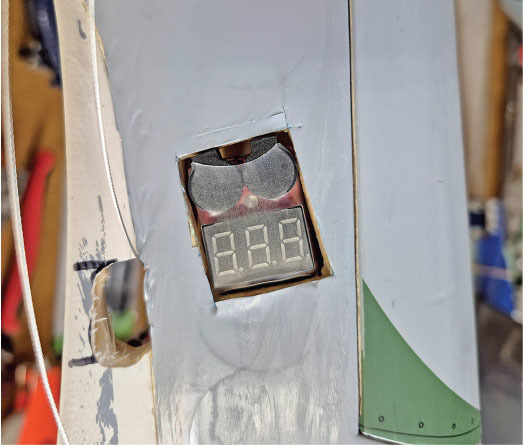
After my unfortunate flameout at the Nats, I’ve started installing onboard voltage monitoring in my electric Carrier models. The units I found are available from many suppliers, and I obtained mine through Amazon for less than $3 each. Search for "LiPo battery low-voltage alarm." There’s no manufacturer name on the units.
They plug directly into the balancing plug on your battery and can accommodate up to an 8S battery. Though the audio alarm is quite loud, you might not hear it from 60 feet away with propeller and motor noise, but the brightly flashing LED light of the alarm is easy to see, even in bright sunlight. You can set the alarm voltage from 2.7 to 3.8 volts, and the alarm is triggered when the first cell drops below that voltage. Weight is only 1/4 ounce. I’ll also use them for monitoring battery discharge for conditioning and storage.
Nats Equipment
I have traditionally used the December "CL Navy Carrier" column to discuss the equipment used at the Nats and how it performed. This year, as in the recent past, the internal-combustion engines were the same ones we’ve seen in the past. That’s true primarily because there have been no new competition engines suitable for our events since the Nelsons were introduced years ago. That fact results in a wide variety of equipment being used.
In the traditional Carrier events, the only trend is the increased use of 2.4 GHz radio equipment for controlling the throttle and other functions. Radios designed for land and water use are being modified or used as-is with a separate control handle. The new equipment being utilized is the LineMaster 2.4 GHz handle, which I’ve discussed previously in this column. Only one of the new units was flown at the 2025 Nats because they were not released to the public until after the event had taken place. More can be anticipated in the future.
Performance remains about the same. The line drag from two lines is only slightly less than that for three lines, and with the continued use of legacy engines, high speeds remain as they have been in the past.
In the electric-class events, high-speed performance remains very close to that of the internal-combustion events. The best high speed this year was in Electric Class I at 104.3 mph—only slightly faster than the highest speed in prior years. With increasing participation in the electric events, some trends are emerging in the motors that are used. The BadAss motors from Innov8tive Designs were the predominant power systems, with the majority being 2820- or 2830-size motors with ratings of 1,820 Kv or 1,350/1,360 Kv. In the .15 and Skyray events, with their speed limits set for high speed, there was a wide variety of equipment in use.
New Technology
My Supermarine Seafire for the Electric Carrier II class didn’t get completed in time for the Nats or this column, but I’ll talk about it and the new technology I’m trying out on it in my June 2026 "CL Navy Carrier" column.
Meanwhile, keep your tailhook dry!
SOURCES:
Navy Carrier Society (NCS)



Comments
Add new comment