By Travis McGinnis
As seen in the August 1993 Model Aviation.
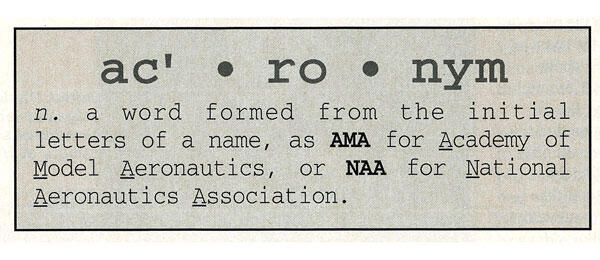
Acronyms, acronyms, acronyms ... What do they stand for? What do they have to do with model airplane builders and fliers?
To cash in on an old saying, here's everything and more than you ever wanted to know about the organizations that affect you as a model airplane enthusiast.
Let's go back to the first question and get acquainted with some organizational descriptions and roles. AMA stands for Academy of Model Aeronautics. This is the organization that can be of the most help and assistance to the average sport flier—as well as most competition fliers—throughout the country. (Don't overlook your local hobby shops and area clubs, however.)
The AMA is a division of the National Aeronautic Association (NAA). The NAA, in turn, is the official US representative of the Fédération Aéronautique Internationale (FAI), the world governing body for sport aviation.
Unless your interest is in full-scale aviation (the kind you strap your body into and fly), you can pretty well skip the NAA and go to the FAI for international modeling information. Just know that the NAA—the US's national aero club—is AMA's parent organization and has delegated supervision of FAI-related modeling activities (such as record attempts, competition sanctions, and selection of US teams for aeromodeling world championships) to AMA.
A global view of these organizations is: FAI (worldwide), NAA (US representative to FAI), and AMA (the NAA branch dealing with model activities).
This article focuses on the FAI organization, so let's look at its makeup. The FAI was founded in 1905—just two years after the Wright brothers' first powered flights at Kitty Hawk, North Carolina (or four years after Whitehead's powered flights in Connecticut—whichever account of first flight you choose to believe). The FAI's basic aim is to further worldwide aeronautical and astronautical activities. In its years, the FAI has grown from only three founding members—Belgium, France, and Germany—to more than 70 member countries.
FAI activities include the establishment of regulations to evaluate and compare performance of all existing aircraft and space vehicles; control and certification of world aeronautical and astronautical records; and the establishment and application of regulations to aeronautical events. The FAI promotes skill, proficiency, and safety in its activities and confers medals, diplomas, and other awards to those who contribute to these aims.
To achieve and further these goals, the FAI brings together representatives of aviation sporting activities from all over world. For each activity there is an international committee, to which any FAI member country may send delegates to contribute new ideas.
The CIAM (yup, another acronym!—International Aeromodelling Commission) now comes into the picture. The CIAM meets once a year, usually at FAI Headquarters in Paris, France, for a formal Plenary (planning) session, passing its work for approval and technical clearance to the International Aeronautic Sporting Committee (CASI), then on to the FAI Council before ratification and the next meeting of the General Conference—an annual meeting of delegates from FAI member countries.
The FAI Council consists of the FAI officers and the president of the CASI. It meets annually to cover matters referred to it by the General Conference and is the body through which FAI policy is implemented. The CASI, which includes representatives from all member nations, keeps the Sporting Code up to date, makes recommendations for changes, arbitrates disputes, establishes guidelines for selection of international judges, and reports to the General Conference. Each FAI member (AMA, for the US) may annually appoint a delegate to the CIAM. This delegate then votes on the proposals submitted to the annual CIAM meeting.
By authority of the AMA Bylaws, the AMA president, who is responsible for FAI matters in the United States, appoints the CIAM voting delegate for the US
The CIAM uses specialists for consultation in its yearly technical meetings. These specialists serve on subcommittees for the technical meetings and are consultants only, not representatives of their home countries. The CIAM voting delegate is responsible for voting on technical meeting material—a big job, requiring lots of input, the ability to assimilate, the ability to prioritize interests, and a certain amount of negotiation and PR ability.
The subcommittee chairmen preside over the technical meetings in their specialty during the first day of the annual CIAM subcommittee meetings. AMA has several consultants serving in this capacity—it gives us good insight and a certain amount of firsthand information.
The chairman leads the meeting through its agenda and conducts straw votes to see if there is enough support to present individual items to the Voting Delegate the next day.
The chairman then presents the items, with comments and recommendations from the technical meetings, to the Plenary assembly. He is also responsible for a detailed written report of the technical meeting's work, which is to be shared with the total CIAM Plenary attendees. Each chairman also directs the continuing business of his subcommittees by mail during the year between meetings.
Between meetings, the detailed work of organizing the next world championships and drafting proposals for higher achievement standards continues in working groups or by individual delegates. This FAI work has the general objective of international excellence, and the results are free to be used at national or local events.
Responsibility for the dayto-day operations of the FAI is that of a headquarters staff in Paris, France, headed by a Director General. This appointment is made by the FAI Council.
Reviewing a recent event calendar, we find that FAI activities included four aeromodeling world championships, three continental championships, and 87 open invitational events. That's a bunch of worldclass aviation activities, folks!
If you have waded through all the above and still want more information about model types and categories recognized by the FAI, check out the 200-plus-page book devoted to defining these models and their exact specifications: The FAI Sporting Code is available download on the FAI website at www.fai.org/page/ciam-code.
Category Fl: Free Flight is flight during which there exists no physical connection whatsoever between the model and the competitor/flier or helper. There are nine categories of Free Flight, described as:
FIA: (A-2 class) Gliders are towed aloft then released to fly alone and timed for a maximum of 3 minutes. This is done with a towline not exceeding 50 meters in length.
FlB: Models have extensible motors. This is what we would commonly define as rubber powered; models are hand launched with a timed flight.
FlC: Models use piston-type motors. Glow plug or compression ignition (diesel) motors may be used. A standard fuel, consisting of 80% methanol and 20% castor oil, is required for glow plug engines. Both the motor run and length of flight are timed to a specified maximum.
FlD: Indoor models are flown in an enclosed space and are powered by extensible (rubber) motors. Timing for the flight begins after hand launching. Records are kept for four ceiling height categories, ranging from less than eight meters to higher than 30 meters.
FlE: Gliders with automatic steering, or Slope Soaring gliders. These models are hand launched from a suitable slope facing the wind and are timed. These models use a steering device that cannot be controlled by the competitor during flight.
FlF (Helicopter), FlG (Coupe d'Hiver), FlH (A-1 class gliders), and FlJ (1/2A Gas) are provisional Free Flight categories. They are not flown in world championship competition and are defined in a supplement to the Sporting Code.
Category F2: Control Line is flight in a circle where the model is controlled by one or more wires held by the model pilot.
F2A: Speed models powered by a piston motor are flown at a sustained maximum speed over a measured course.
F2B: Aerobatic models powered by piston motors are flown through a prescribed set of maneuvers.
F2C: Team Racing is an event in which three special Racing models are flown simultaneously in the same circle. Each is flown by its own pilot over a specified number of laps. A mechanic helps with necessary pit stops. The event is timed over the prescribed distance or number of laps.
F2D: Combat is flown by two airplanes/pilots simultaneously from the same circle, each towing a paper streamer about three meters long. The object is to cut the opposing airplane's streamer without getting your streamer cut-a sort of war that has much spectator appeal and often much action and crashes. Mechanics are used to assist with any restarting or replacement of equipment throughout the timed event. A bunch of rules exist for safety and sportsmanship in this exciting event. Out of necessity, Combat fliers probably build more airplanes than most other modelers.
Category C3: Radio-controlled flight is defined as flight during which the model is aerodynamically maneuvered by control surface(s) in attitude, direction, and altitude by the pilot on the ground using radio control.
F3A: Aerobatic power models fly before a panel of judges through a prescribed series of maneuvers controlled by the competitor/ pilot by a hand-held radio. An extensive judge's guide describes the maneuvers in detail, complete with downgrades for mistakes or flaws in presentation. As with many other events, judges and pilots alike must be well versed on the intricate and subtle execution of the various maneuvers.
F3B: Thermal Soaring is a multitask timed event for RC gliders (often called sailplanes) that includes duration, distance, and speed. Models are launched by either hand-towing, powered winch, or hand-operated pulleys.
F3C: Helicopter. Like the aerobatic airplanes, helicopters are flown through a series of judged maneuvers.
F3D: Pylon Racing models are replicas of full-scale racing airplanes that race up to four at a time around a triangular course for 10 laps. In this timed event, judges watch for pylon cuts (turning inside the pylon, instead of outside), and they assist with lap counting. All-out speed and precision flying are essential to win in this event.
F3E: RC electric-powered models are somewhat new on the competition scene, and events provide for motor gliders (sailplanes) with tasks in distance, duration, and landing. Included are aerobatics, with a flight schedule similar to the F3A RC Aerobatics event; Pylon Racing, similar to F3D; and a Stand-Off Scale event-all using electric motors powered by rechargeable batteries.
Category F4: Scale models are replicas (miniature copies) of heavier-than-air, mancarrying aircraft. There are categories for Free Flight (F4A), Control Line (F4B), and RC (F4C). Each category has its own set of guidelines on documentation for proof of scale, scale accuracy, craftsmanship, scale detail, static judging, and flight judging. Scale models often draw large crowds of spectators at competitions and provide realistic flights of the specific airplanes modeled.
With the aid of these brief outlines of the various model categories, you will be better informed as to how the acronyms of aeromodeling affect the rules of safety, sport, and competition activities in the modeling areas you enjoy most.
SOURCES:
FAI
www.fai.org
FAI Team Information
www.modelaircraft.org/events/world-championships/fai-team-information




Comments
Add new comment