I’VE BEEN FLYING the Control Line (CL) Navy Carrier event for almost 60 years, and I have found it both enjoyable and rewarding. For me, the event has both a design aspect that appeals to my engineering side and a historical aspect that appeals to my military side. The event combines high speed, low speed, and precision and uses skills and technology that are different from what is required for other events. Those skills are not difficult to learn, making the transition to enjoying Carrier relatively easy, yet they are challenging enough to make improving your scores a rewarding experience.
The best part of flying CL Navy Carrier for me is the great people who participate in the event. While the competition is serious, our events are friendly, with all contestants pitching in to ensure that everyone has a chance to achieve their best performance. We all join in celebrating one another’s accomplishments and share in the joy of a first flight in a new event or of a new model, a new personal best, or a winning performance.
The Special Interest Group for CL Navy Carrier is the Navy Carrier Society (NCS). The NCS publishes the High-Low-Landing newsletter as a means of sharing contest results, technologies, ideas, and photos of member designs. The newsletter also provides a listing of the scores that have been achieved throughout the year in each of the competition categories to allow members to track their performance improvements and see how their scores compare with other flights throughout the country.
Because I’m an officer in the NCS, becoming a member is as simple as contacting me through email, which you can find at the beginning of this article. Our members are eager to share their experience and expertise with modelers who want to learn more about the event, and I’m happy to connect those who are new with experienced NCS members who can serve as mentors and make the transition to flying CL Navy Carrier an enjoyable experience.
Electric Propeller Adapters
There are a couple of different ways to mount a propeller on an electric motor. All motors have a shaft protruding from the stationary end that can accommodate a propeller adapter. A common type is a collet that uses a tapered cone in the propeller mount to clamp the shaft and retain the adapter by friction.
I’ve encountered a few instances in which the collet-style adapter has loosened while the motor is running—other modelers have as well. This situation creates a potential hazard to ground personnel and spectators from the fast-moving propeller. Vibration seems to be a common thread for all incidents of liberated propellers. A balanced propeller and a tight-fitting propeller hub to the adapter shaft are essential for reducing vibration. Using the centering ring on APC propellers that have this feature is a good idea, and it is essential if the propeller mounting hole is not a snug fit on the shaft.
Although it’s not an option on all motors, it is usually possible to position the fixed end of the motor either facing forward or facing aft. When I’m able, I’ll switch to mounting my electric motors with the nonrotating end facing aft and equipping the motor with a propeller adapter that is bolted to the rotating portion of the motor. As a bonus, adapters from Innov8tive Designs (BadAss Power Systems) include a tapped hole in the end of the shaft for spinner attachment.
New Technology
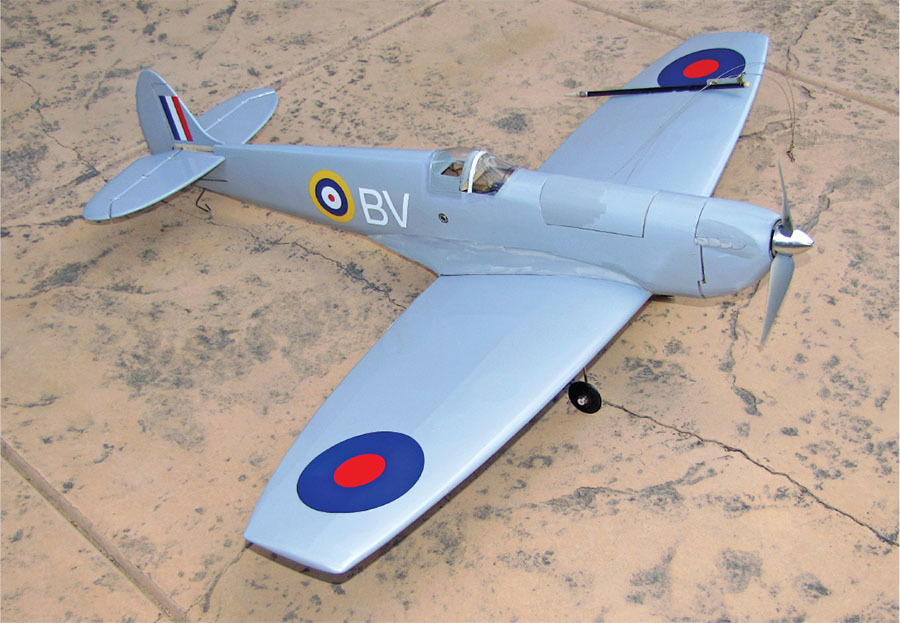
My Supermarine Seafire for Electric Class II is finally in the last stages of completion, and I’m looking forward to the first flight as I write this column. It is a rather extensive "kit-bash" project that started from a balsa Spitfire RC ARF that is no longer in production. It required modifications to convert it to CL, of course, and a year ago in this column, I discussed many of the structural considerations that went into those modifications

Power Up Your Starter!
"A trusted name in RC model aviation for 7 decades!"
Fits Hi-Tork, Dynatron & Megatron Starters!
Supports up to 6S LiPo Batteries!
sullivanproducts.com • 410-732-3500

RC2 15/16th’s RC3 Worm Burner
Designed by John Hoover
Kits are laser cut & made in the USA using Bud Nosen Wood and US hardware.
Full size Rolled Plans and Printed instruction Manual make for a smooth build.
Visit our "Media" section on our website to view construction photos.
Wing Span – 38" $99.99 + Shipping
Wing Span – 38" $89.99 + Shipping
Aspect Laser kits are carefully designed to be light but strong!
Visit aspectlaser.com or check us out on eBay to order our kits and see the other exciting products!
Contact Us: aspectav5429@yahoo.com
I replaced the horizontal stabilizer and elevator for increased strength and to meet the scale requirements of our event (none of the model’s control surfaces had balance horns). The fuselage and wing were designed to the same scale with accurate outlines, except the nose was way too long on the original ARF. It is now an appropriate length, which also made for better balance with the larger and heavier electric power system. I had to move the cockpit aft to the scale position as well. The original elliptical wingtips were shortened to meet the 44-inch wingspan requirement and produce the clipped-wing, low-altitude Seafire L Mk.II variant.
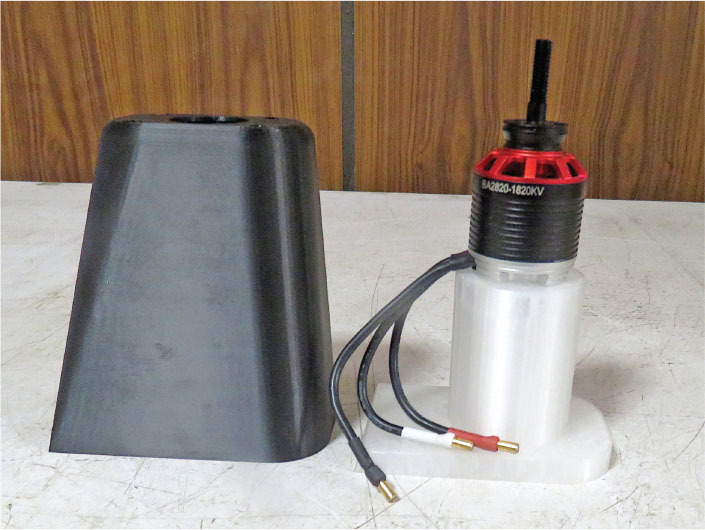
I incorporated several things that I have not tried before to see how they would work and to evaluate their performance advantages, if any. In the December 2025 "CL Navy Carrier" column, I described the onboard battery voltage monitor that I’ll be using to avoid surprise flameouts. I used the BadAss 3D-printed motor mount that is intended for 28 mm motors. The mounting dimensions are identical for the BadAss 28 mm motors and for the 35 mm motors (which I intended to use). The smaller-diameter mount fits inside the ARF’s cowling perfectly. The wide variations in motor-mount lengths that are available from Inno8tive Designs make it easy to adapt to any motor option that I might want to try.
The rudder is moveable and controlled with a servo. The settings for straight, intermediate, and full deflection will be completely adjustable using the programming capabilities of the LineMaster 2.4 GHz Typhoon control system that I described in previous columns. I expect to use an intermediate position for takeoff. I will use standard-rotation (right-hand) propellers because of the greater variety that is available for evaluation. The rudder will go to the streamlined position for high speed and full deflection for slow flight— again, because of the right-hand propellers that I’ll be using.
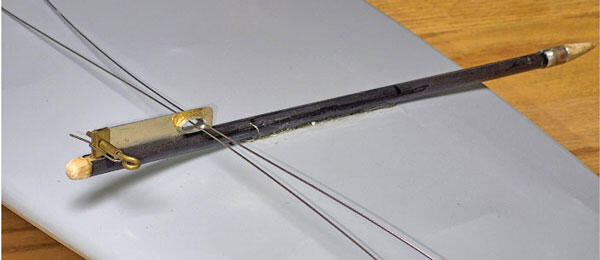
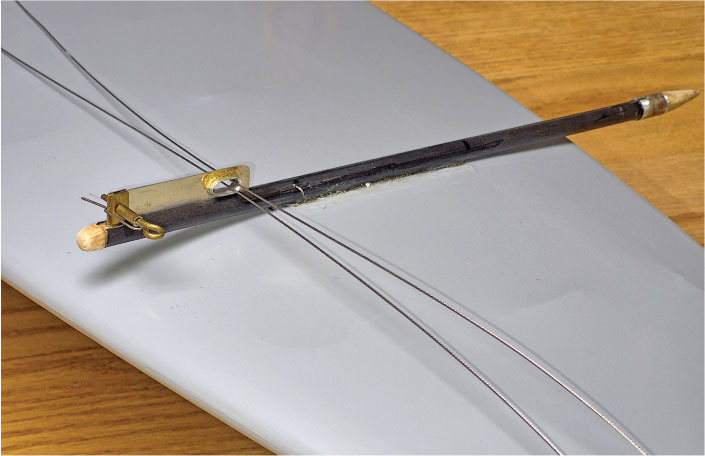
For lower drag and lighter weight, I fabricated the slider frame from a carbon-fiber/aluminum composite arrow shaft. The slide has a steel disk at the rear end, which is retained in the aft position by a small rare-earth magnet inside the arrow shaft. I installed E-flite electric, integral-actuator, retractable landing gear, which matched the mounting dimensions of the ARF landing gear. I’ll be able to assess the advantage, if any, of retractable landing gear for our event.
I’ve also installed the Castle Creations Arm Lock Key Harness as a secondary safety device to prevent the ESC from arming once the battery is connected. My helper will still need to hold the model until it’s ready to arm, but the arming will be a simple, one-handed operation.
I’m excited to test-fly a relatively new 9 × 8E three-blade electric propeller from APC. The APC 10 × 8E propeller is fairly common in the electric Carrier events. Testing by Innov8tive Designs showed that, compared with the APC 10 × 8E, the APC 9 × 8E three-blade propeller produces 5% more static thrust at a 14% lower current/power. Those numbers indicate that the 9 × 8E three-blade propeller uses power more efficiently, which could allow reduced battery weight, better acceleration, and longer duration for low-speed flight.
When I use a two-blade propeller, I’ll try the scale-size ventilated Air-Flow Spinner from Innov8tive Designs, which is designed to pump cooling air into the cowling through the spinner.
3D-Printed Carrier Model Parts
Melvin Schuette is fabricating 3D-printed parts for his Carrier models. Let me know if you are also using 3D printing for your CL Navy Carrier projects.
Keep your hook dry!
SOURCES:
E-flite



Comments
Add new comment