IN THIS ARTICLE, I want to take a deeper dive into judging, the best practices, and even some criteria that you should find helpful.
Judging is the backbone of every contest. If you fly in a contest, you are expected to judge the next class up from where you are competing. If you are a new pilot, you might get a pass for a contest or two, or you can ask for some assistance or to shadow another judge to help you understand what you should be looking for. Always be prepared to judge and use the maneuver descriptions and the Aresti Catalog to learn the pattern for the class you are judging. This not only helps you be a better judge but also helps you understand the class you are aiming to move into.
Best Place to Judge Accurately
You will want to sit behind the pilot, not more than 10 meters and not less than 7 meters; this way, you can accurately see the center. If you sit too far in either direction (left or right) of the pilot, your view can become skewed, and you might not see the center or opposite box markers correctly.
Find the box! Before the pilot takes off, don’t hesitate to stand up and find the box markers from your view. Utilize a point that you can recall quickly to know whether the pilot is in or out of the box. Do this each time if it is needed.
In the Chair
All maneuvers should be executed with:
- Geometrical accuracy.
- Constant flying speed.
- Correct positioning within the maneuvering zone.
- Matching to the size of the maneuvering zone.
The overall criterion for judging is:
- The type of defect.
- The severity of the defect.
- Use the one-point-per-15° rule.
- Lines should be judged more critically than deviations in yaw or roll.
- Don’t worry about who is flying or what they are flying. Score the flight and be consistent regardless of the situation or environment.
Every maneuver starts with a 10. You downgrade minor errors in .5-point increments, and major errors in one-point increments.
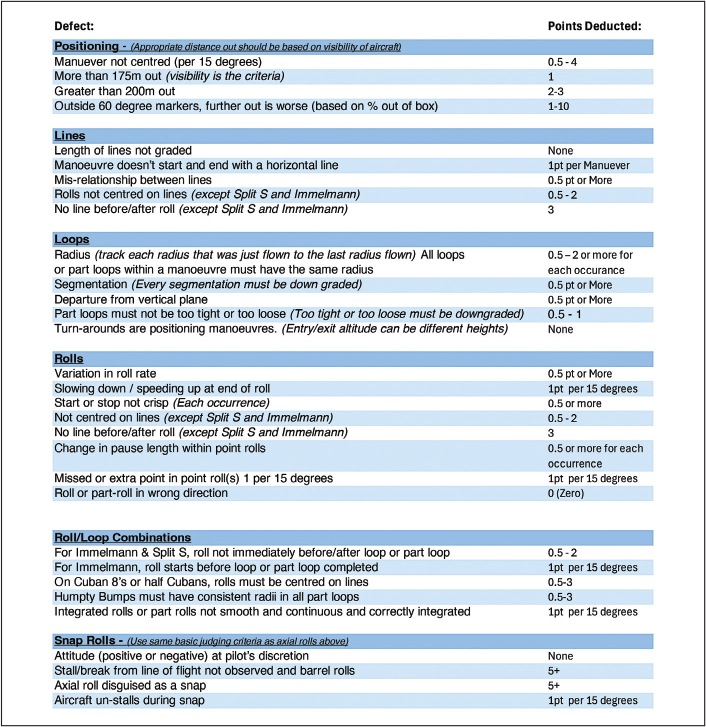
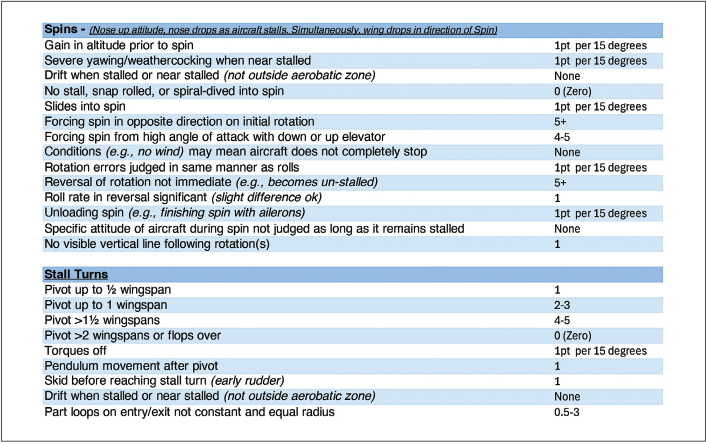
A PDF of the judging guide can be downloaded on the Model Aviation website here:
If you didn’t see a maneuver, don’t make up a score; use "NO" for "Not Observed." Use the guidelines for general downgrades.
Take the time to review the FAI Sporting Code for further details and to be a consistent, fair judge!
Until next time!
SOURCES:
National Society of Radio Controlled Aerobatics (NSRCA)
FAI Sporting Code
Section 4—Aeromodelling, Volume F3, Radio Control Aerobatics, 2025 Edition


Comments
Add new comment