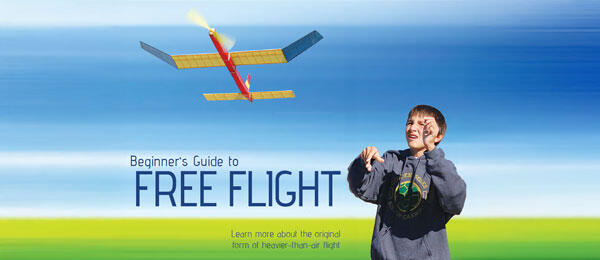
Learn more about the original form of heavier-than-air flight
By Don DeLoach; email: ddeloach@comcast.net
Photos by the author
As seen in the July 2012 issue of Model Aviation.
What is Free Flight?
Free Flight (FF) is the original form of heavier- than-air aviation, dating back to Alfonse Penaud’s 1871 rubber-powered Planophore. Much has changed since that first 11-second flight in Paris, but the essence of FF remains the same. It is about the purity of flight, and confidence to make an aircraft fly stably and efficiently, with no piloting after the launch.
Probably the easiest way to get involved in FF—or model aviation, for that matter—is with a simple, handheld catapult glider. Plenty of kits exist from various sources, and RTF models are legal for AMA competition.

One of the best is Stan Buddenbohm’s Scout. It is a simple, 16-inch wingspan design that is mostly balsa, easy to build, and flies superbly. Others include the Cata-Piglet from Campbell’s Custom Kits and the Sting series by A2Z.
The idea behind the Catapult Glider event is straightforward: the models are adjusted to launch vertically from a 9-inch, handheld, rubber band-powered catapult. In less than two seconds, they reach speeds in excess of 100 mph and heights of more than 100 feet.
That’s exciting, but then the magic happens as the gliders slow down at the top of the launch, their noses drop, and they transition into slow, circling, floating glides of roughly 5 mph. From a good launch, a well-trimmed catapult glider can remain aloft for approximately 90 seconds without thermal help.
Catapult gliders aren’t difficult to adjust for flights provided one understands the dynamics involved. Rudder offset controls the roll/transition and is effective mainly at launch speeds. Stabilizer tilt and center of gravity (CG) are generally only effective during the glide. And incidence changes affect both launch and glide.
Begin your initial flight trimming by setting the CG at the plans location and hand gliding the model in calm conditions at a local park. Look for a gradual left glide turn with no tendency to spin or dive.

If the model dives, add incidence (stabilizer trailing edge [TE] up) until the model is at the edge of a stall. If the model spins or banks drastically, you probably have a crooked fin or wing.
A proper launch should be pitched up roughly 45° to 60° and banked right at approximately 45°. Reverse this scenario for a left-handed flier; bank left at launch and the trim should be reversed for transition to a right glide circle.
For more than 30 years, the best starting point for powered FF has been the P-30 model. True to its name, this is a simple-to-build-and-fly competition class that provides loads of fun at a low cost. General specifications are a 30-inch wingspan and length, 40-gram minimum weight, and a commercially available 91/2-inch diameter plastic propeller.

An excellent and competitive P-30 kit is the Square Eagle, thousands of which have been built in the past three decades. The Square Eagle can be built in a week of evenings by even the most inexperienced builder. Basic familiarity with stick-and-tissue construction techniques is helpful but not required.
Probably the most important thing about building FF models is recognizing the importance of precision. Sloppiness, at even the earliest stages of construction, will show up later with warped flight surfaces, and a model that is difficult to adjust for flight.
Work on a completely flat tabletop surface. A hollow door from a home store makes a good flat surface. Some builders go a step further and work on 3/8-inch thick (or thicker) glass tabletops.
For most traditionally constructed FF models (balsa wood, open structure), you’ll need a surface you can stick pins into as you frame up structures over full-size plans covered with plastic kitchen wrap.
A good pin board is a 2 x 4-foot acoustic ceiling tile. Even better is the 1/2-inch thick sound-proofing fiberboard available at home supply stores in 4 x 8-foot sheets. Both options are inexpensive; the sound proofing is my favorite because it’s slightly denser and holds pins more firmly.
Small rubber-powered models, such as the P-30, are almost always open-structured balsa frames covered with an ancient but superb material: Japanese tissue. This fine tissue is still made by the Esaki company in Japan, as it has been for generations.

What makes Esaki tissue so desirable for FF is its low density (roughly 3.5 grams per 100 square inches) combined with amazing skin strength when it is water-shrunk. This skin strength translates to finished flying surfaces that are much stiffer than the uncovered structures.
The downside of tissue covering is it is time-consuming and more difficult than iron-on films. It requires the builder to brush on some kind of adhesive. White glue (thinned 50% with water) or unthinned nitrate dope work well. The latter is mildly toxic, so open a window or wear a respirator.
Tissue-covered structures are then dampened with a light mist of water and brushed with two or three light coats of non-tauntening nitrate dope (thinned 50/50 with dope thinner) roughly 5 minutes apart.
This seals the pores of the tissue, makes it reasonably glossy and considerably stronger. In lieu of thinned dope, some modelers use Krylon Crystal Clear #1303 out of a spray can; it works well and is actually slightly lighter.
As previously stated, the importance of precisely aligned, warp-free structures cannot be overstated. Most critical is the vertical stabilizer; glue it on absolutely straight unless the plans say otherwise.
The horizontal stabilizer is also critical. It must be adjustable longitudinally, preferably via a small 2-56 nylon screw on the TE. Small 1/64-inch plywood shims are a passable substitute, although a screw is much better.
No warps should be present in the horizontal stabilizer. Remove any you see with a heat gun or hair dryer. Be careful not to get the structure too hot; balsa and doped tissue are excellent fire starters!
The wing is a different matter. It should have roughly 1/16 to 1/8-inch washout (TE higher than the leading edge [LE]) in the tips. Unless your plans say otherwise, the washout should be equal in both tips. Again, use your heat gun and get the warps right before attempting that first flight.

Your first flight with a P-30 should be an unpowered glide with the 10-gram rubber motor installed and the CG located as shown on the plans. Find a grassy spot and gently toss the model forward with the nose slightly down.
Shim or screw up the stabilizer’s TE until you see a slight stall. This means you’ve slightly exceeded the upper incidence limit for that CG position. Lower the stabilizer slightly and toss again; the stall should be gone. You’re now ready for powered flights.
Your first powered flight should only be attempted in a fairly large field and in light breeze. Wind roughly 50 turns into the motor and release the aircraft, carefully observing it. Chances are that the model will pitch up slightly and power stall or “mush” forward slowly; this indicates a need for downthrust.
Most FF models need approximately 2° to 4° of downthrust for optimum flying. You only need enough downthrust to prevent a power stall at full power; any more than this will limit your climb height.
Keep increasing turns in increments of 50 until you see the model turn in the climb. The desired climb is a right spiral (left is the direction of torque and is unsafe under high power) using slight right thrust. Most rubber models use roughly 1° to 3° of right thrust to affect a right-spiraling climb.
Keep tweaking the thrustline and increasing turns until you’ve reached maximum power, which is roughly 1,100 to 1,200 turns on a typical six-strand x 1/8-inch P-30 motor.
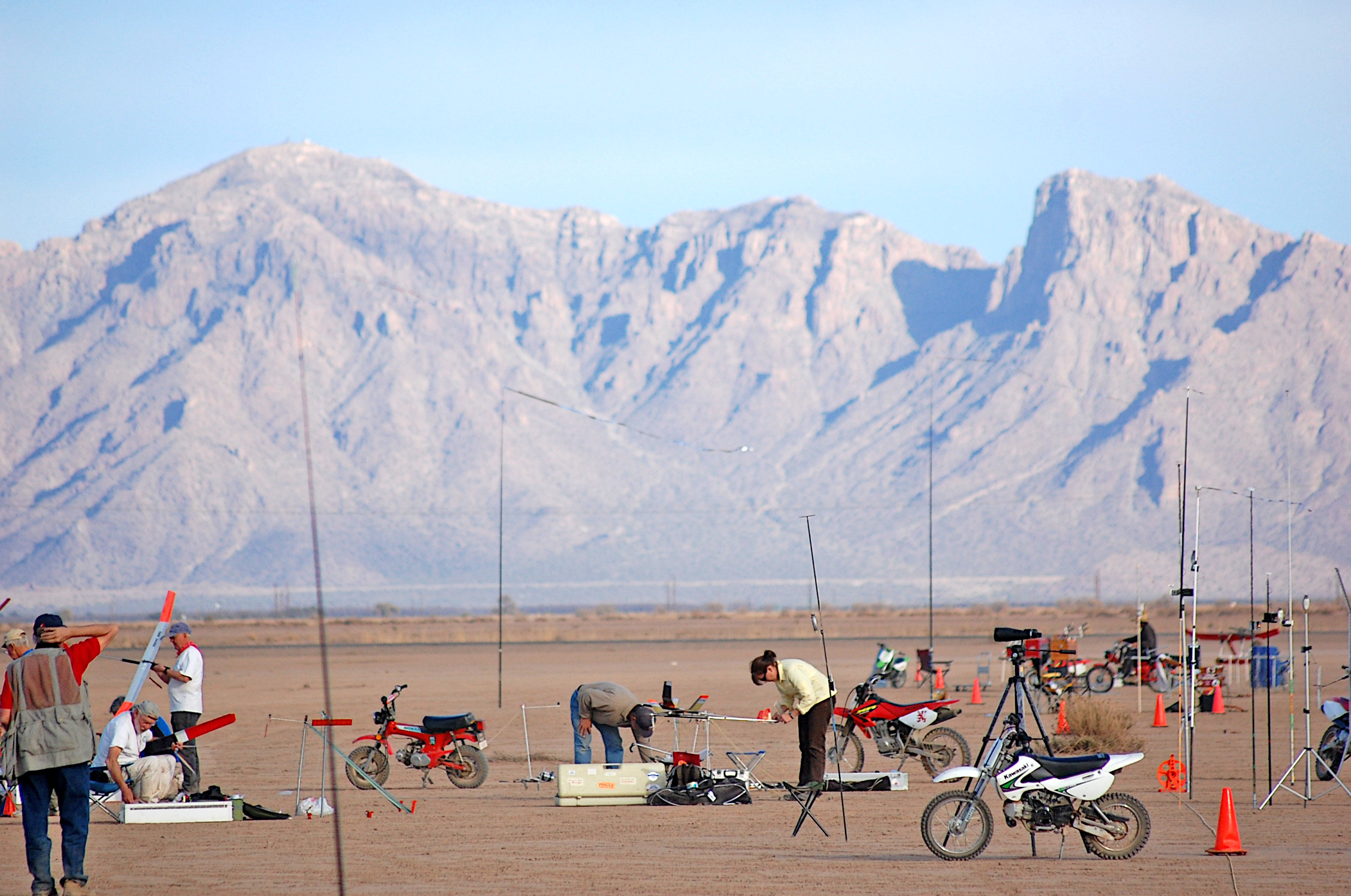
For this you’ll need a mechanical winder and a larger field—200 acres minimum—more if you live in a windy area. Set the DT on every flight; I’ve seen models fly away in thermals from modest heights.

What is a dethermalizer?
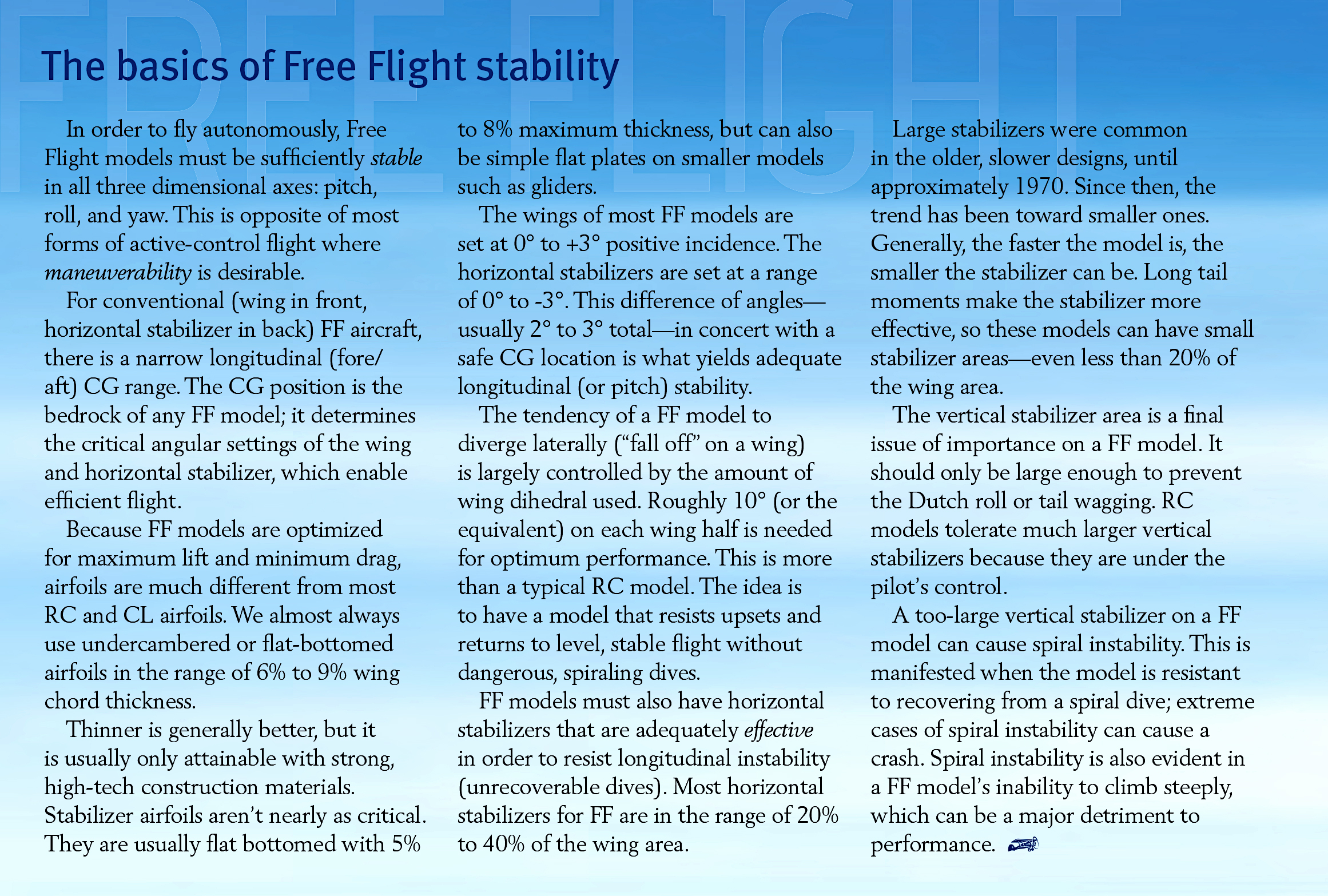
The Basics of Free Flight Stability
Sources:
National Free Flight Society
freeflight.org
FAI Model Supply
faimodelsupply.com
Volaré Products
(269) 339-9795
volareproducts.com


Comments
My granson might like to try
My granson might like to try this.
free flight gliders
Small gliders given to children (Girls and boys) at events here in Austin TEX. A.R.C.A field often generates as much excitement as the events. I have seen the parents get wrapped up in flying the gliders and have a ball. I try to keep this going because it promotes very good relations with the public.
FF Glider kits for beginners.
I have recently designed a new 12" wingspan easily built glider kit especially for introducing children to the fun of model aviation. It is called "camp racer" and is ideal for summer camp type activities as it can be built and flown in under an hour. I also have a glider kit called "sky Bandit" which is put together in 5 mins using only 3 rubber bands. I have given away over 300 of these to kids at both full size and model aviation events. And finally, a foam plate glider that resembles a sead from the tropical vine Alsometra Macrocarpa, more than 500 of these have been given to children at various events like club open houses etc.
The joy that you see on children's faces when you give them the experience of their first flying model is truly amazing.... Retro RC
catapult gliders for kids
My father used to make me balsa wood gliders as a kid. He continued this tradition with my son, and despite his progressing Parkinson's Disease, he would build beautiful catapult gliders, box them up and send them across the country for him to fly. Unfortunately, they rarely lasted long, and I, unfortunately, was never taught the art of building gliders. My father passed away this January and I would love to figure out how to find some of those gliders. We're thinking of flying some of them at his burial in July in lieu of releasing balloons. It's much more fitting, since my father had a lifelong love of model airplanes. Any ideas on how I can find some? My son is older now (10), and I think they may last a little longer than they did in the past...
FF
I like to get my son involve so that he can gain experience for the Science Olympics
Simple model airplanes for beginners and teachers
See www.EndlessLift.com for posts on building an AMA Cub and several variations, other simple model airplanes, a foam Zanonia seed glider, paper gliders used to teach science, engineering and mathematics.
links
Thanks Gary for sharing your link. Great way to introduce modeling along with hands-on experience with science, math, and engineering.
Glider from foam, cardboard, and bamboo
Just wanted to add the link to glider construction article I provided on my website that can be constructed from materials found at the grocery store. http://www.scienceguy.org/Articles/HammerDownCatapultGlider.aspx
Bill Kuhl
glider link
Thanks Bill. Great link on how to build a glider out of everyday items in your typical grocery store!
free flight turns
Long ago I saw a man launch a high-wing free flight model that slowly turned in a large spiral upward and descended the same way when the fuel ran out. I have wondered about how t make a plan do that without rolling or spinning out. Any ideas?
Add new comment